







In blackjack, an Ace counts as either 1 or 11, and that flexibility creates a “soft” hand. A soft 17 forms whenever an Ace combines with other cards to total 17 while counting the Ace as 11. The classic example is Ace-6. The Ace counts as 11, the 6 adds normally, and the total reaches 17 with zero risk of busting on a hit. Other combinations reach the same total through different paths, including Ace-2-4 and Ace-3-3. Compare that to a hard 17, such as 10-7, where every card holds a fixed value without an Ace cushion to fall back on.
The Glossary of Card Game Terms lists “soft hand” as standard terminology across most card games that use Aces, rather than a house-specific quirk invented by a particular casino.
Soft 17 vs. Hard 17: Spotting the Difference
A hard 17 like 10-7 or 9-8 leaves no room for error. Hit it, and nearly every card left in the shoe busts the hand. Basic strategy is blunt here: always stand on hard 17, no exceptions, regardless of what the dealer shows. Soft 17 plays by different rules entirely. Because the Ace can drop from 11 down to 1, hitting a soft 17 never risks busting on the next card; worst case, the total converts to a hard count instead.
That built-in safety net opens up decisions that hard 17 prevents outright. A player holding Ace-6 against a weak dealer upcard can hit or double down, options that would be reckless with a hard 17.
Why the Dealer’s Soft 17 Rule Matters
Casinos do not all play soft 17 the same way, and that single rule carries more weight than most players realise. Under the H17 rule, the dealer must hit a soft 17 instead of standing, drawing another card in search of a stronger total. Under S17, the dealer stands pat on that same hand. On the surface, hitting looks riskier for the house, and it is slightly, but the maths works against the player overall. When a dealer hits soft 17, the extra card raises the odds of both busting and improving to 18, 19, or 20. Blackjack analyst Stanford Wong calculated that this single rule variation shifts the house edge by about 0.2 percentage points in the casino’s favour compared to S17 tables.
The dealer’s chance of busting increases by about 0.4%, but their odds of improving to a total of 18 or higher go up by roughly 0.80%. Across thousands of hands, that slight edge adds up to real money leaving players’ pockets. Rule distribution varies sharply by market. Nevada casinos, including many along the Las Vegas Strip, spread a mix of both rules, though H17 has become more common at lower-limit tables. In the UK and across continental Europe, S17 remains standard, partly because European no-hole-card rules favour the house in other ways, so operators balance the maths differently. Online platforms add another layer, with sites like PlayOJO listing dealer rules per table, since digital blackjack variants across America and abroad run either version depending on the software provider. WinStar World Casino, one of the largest card-room operators anywhere, publishes its rule sheets table by table, while outlets like Current Blackjack News track these variations across properties.
In the United Kingdom, the ‘Dealer Stands on Soft 17’ (S17) rule is standard across virtually all online casinos, making it a more player-favourable market in this regard.
| Rule | Dealer Action on Soft 17 | Approximate House Edge Impact |
|---|---|---|
| S17 | Dealer stands | Baseline |
| H17 | Dealer hits | Roughly +0.2% toward the house |




Common Misconceptions About Soft 17
Many players assume any 17 is strong enough to stand on, but both soft and hard 17 carry a negative expectation against most dealer upcards. The house wins more often than not unless the dealer busts. The exception is soft 17’s flexibility: because it cannot bust on a hit, it rewards an aggressive play in specific spots rather than a passive stand.
How to Adjust Strategy Against Soft 17 Rules
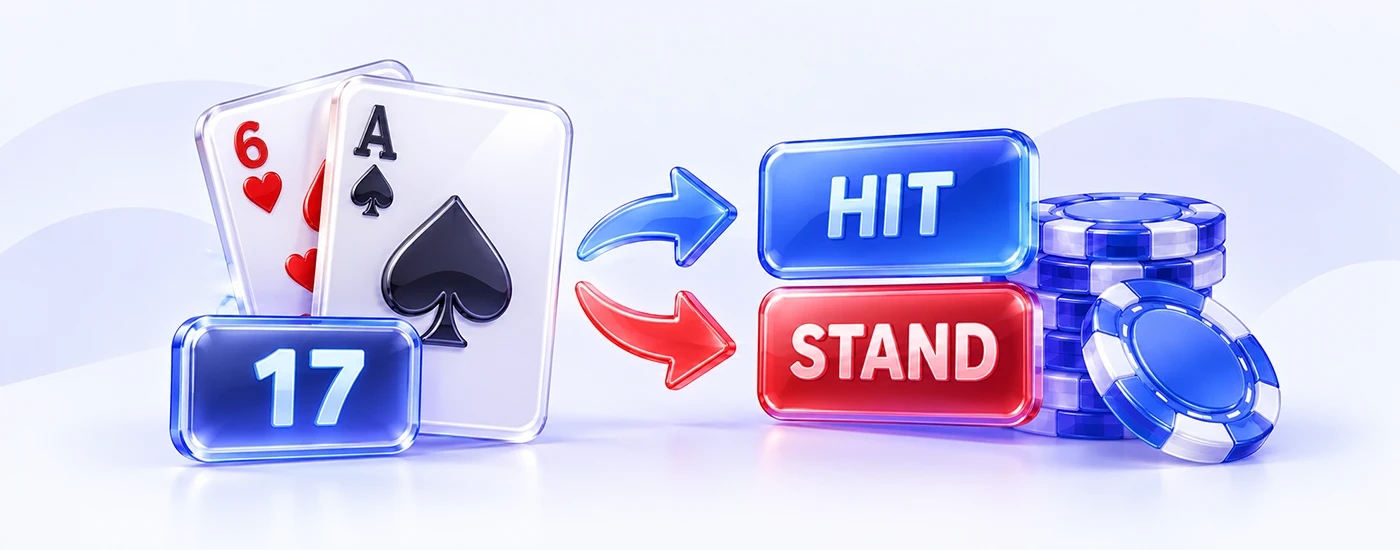
How to Play Your Soft 17 Hand (Ace-6)
As a player, you should never stand on a soft 17. The correct play depends on the dealer’s upcard, as basic strategy aims to maximise your advantage. The table below applies to standard multi-deck games.
| Dealer’s Upcard | Player’s Correct Action |
|---|---|
| 3, 4, 5, or 6 | Double Down |
| 2, 7, 8, 9, 10, or Ace | Hit |
Basic strategy charts shift slightly depending on whether a table runs H17 or S17 rules, primarily affecting doubling and surrender decisions across specific hands:
- Holding Ace-6 against a dealer’s Ace: on H17 tables, surrender if it is offered; on S17 tables, hitting is usually the better play instead.
- Holding Ace-7 against a dealer’s Seven, Jack, Queen, or King: stand on S17 tables; on H17 tables, some charts favour a double against weaker upcards like 3 through 6.
- Holding Ace-2 through Ace-5 against a dealer’s weak upcard (4, 5, or 6): double down on most charts, H17 and S17 alike, since the dealer’s bust risk is high.
- After hitting a soft 17 and drawing a new card: if the total reverts to a hard 17, stand. If it climbs to 18 or higher, stand. If it drops lower, keep following basic strategy and hit again as needed.
Does Soft 17 Strategy Change With the Number of Decks?
Yes, in one notable case. In single- and double-deck games, basic strategy calls for doubling down on a soft 17 (Ace-6) against a dealer’s 2, a play that does not hold up in standard six-to-eight-deck shoe games because card-removal effects shift the underlying odds. Confirm how many decks the table uses before buying in; the soft-hand definition never changes, but the correct play around its edges sometimes does.
Where to Find the Best Soft 17 Rules
S17 tables have become rarer at lower limits, with many Las Vegas Strip operators adopting H17 to expand house margins. S17 rules remain accessible primarily in higher-limit rooms or at properties using player-friendly rules as a marketing feature.
Informational platforms like BestOnlineCasino.com, tracking services like Current Blackjack News, and research from Stanford Wong help players identify optimal table rules across online lobbies and land-based resorts before depositing or traveling.
Never evaluate a table on the soft 17 rule alone. A table that hits soft 17 might offer compensating rules like late surrender, double after split, or fewer decks. A six-deck S17 game lacking surrender or double after split can carry a higher house edge than an H17 table featuring a liberal rule set. Always weigh the complete ruleset.

Frequently Asked Questions
Is soft 17 good or bad for the player?
Soft 17 is neither inherently good nor bad; it is simply a flexible hand. Because the Ace can count as 1, hitting carries no bust risk, making soft 17 one of the few 17-point totals where aggressive play beats a passive stand.
What’s the difference between H17 and S17?
H17 requires the dealer to hit a soft 17, whereas S17 mandates that the dealer stands. Hitting increases both the dealer’s bust chance and their likelihood of reaching 18 or higher, shifting the house edge roughly 0.2% toward the casino.
Does the soft 17 rule affect online blackjack too?
Yes. Online casinos program dealer behaviour using the same parameters as physical tables. Platforms vary, as some run H17 while others use S17, so check the rules panel before playing any digital variant.
What’s an example of a soft 17 hand?
Ace-6 is the standard example: the Ace counts as 11, the 6 adds normally, and the hand totals 17. Ace-2-4 and Ace-3-3 reach the same soft total through different card combinations.
Why should you never stand on a soft 17?
Standing on a soft 17 leaves you with a weak total that generally only wins if the dealer busts. Hitting or doubling down takes advantage of the Ace’s flexibility to improve your total with zero risk of busting on the immediate hit.
How do I know which soft 17 rule a table uses?
Casinos display the rule on the table itself. Look for text printed on the felt, usually near the blackjack payout information, that says either “Dealer Stands on Soft 17” (S17) or “Dealer Hits Soft 17” (H17). If you cannot find it, you can always ask the dealer before playing.
Is a soft 17 considered a good hand?
No, a soft 17 is statistically a weak hand with a negative long-term expectation, meaning it loses more often than it wins. It typically only wins if the dealer busts. However, its value comes from its flexibility; because you cannot bust by taking one more card, it gives you a risk-free chance to improve to a stronger total like 18, 19, 20, or 21, an opportunity a hard 17 does not offer.