








Sic Bo is a classic three-dice game where the whole point is predicting what will show up when the dice are rolled. Its origins are commonly linked to China, and the name is often explained as meaning “precious dice”. Over time, the game travelled well beyond Asia and became familiar worldwide, including in online casinos.
The online version keeps the same simple foundation, but it makes the first steps easier by putting every bet type clearly on the layout. You choose a bet on the table, confirm it, and then the dice roll; your payout depends on how closely your pick matches the result. You can start with easy options such as Small or Big, then move on to totals and specific combinations, where payouts are usually higher because those outcomes land less often.
In this Sic Bo guide, beginners will learn the basic objective of the game, how to play Sic Bo, how dice rolls work, how to read the table layout, how a round progresses step by step, and common beginner mistakes to avoid.
The Goal: Predicting the Roll
The goal in Sic Bo is always the same: pick an outcome in advance that matches the result of a three-dice roll. In every round, you place your bet before the dice land, and that choice is what decides whether you win or lose. Once the wager is confirmed, there is no second chance, so it helps to be clear on what you are actually predicting.
The simplest predictions are tied to the total range. A Small bet covers totals from 4 to 10, while a Big bet covers 11 to 17. These are popular with beginners because they are easy to read and do not require you to learn many patterns. From there, you can narrow your target by betting on a specific total (such as 8 or 13), a specific pair, appearance of a specific number (1–6), or a two-number combination. The more precise the target, the less often it lands, so the payout is usually higher.
Seen the right way, you are not just guessing. You are choosing how narrow you want your prediction to be and how much risk you are comfortable taking.
Dice Mechanics
The Sic Bo casino game uses three standard six-sided dice, so every result is a set of three numbers from 1 to 6. That leads to two practical points. First, the total can only fall between 3 and 18, but the extremes are uncommon because they require every die to feature 1 or 6, accordingly. Second, the same total can be made in several ways, which is why total-based bets tend to come up more often than precise picks like a specific pair or a particular combination.
The dice can land as a triple (all three the same), a pair (at least two the same), or three different numbers. This matters because many betting areas pay based on matching faces rather than the total. For example, a specific number bet is settled by how many times that number appears in the roll, once, twice, or three times.
The mechanics are the same in RNG and live Sic Bo. The only difference is how the outcome is produced and shown to you.
Table Layout (Interface Guide)
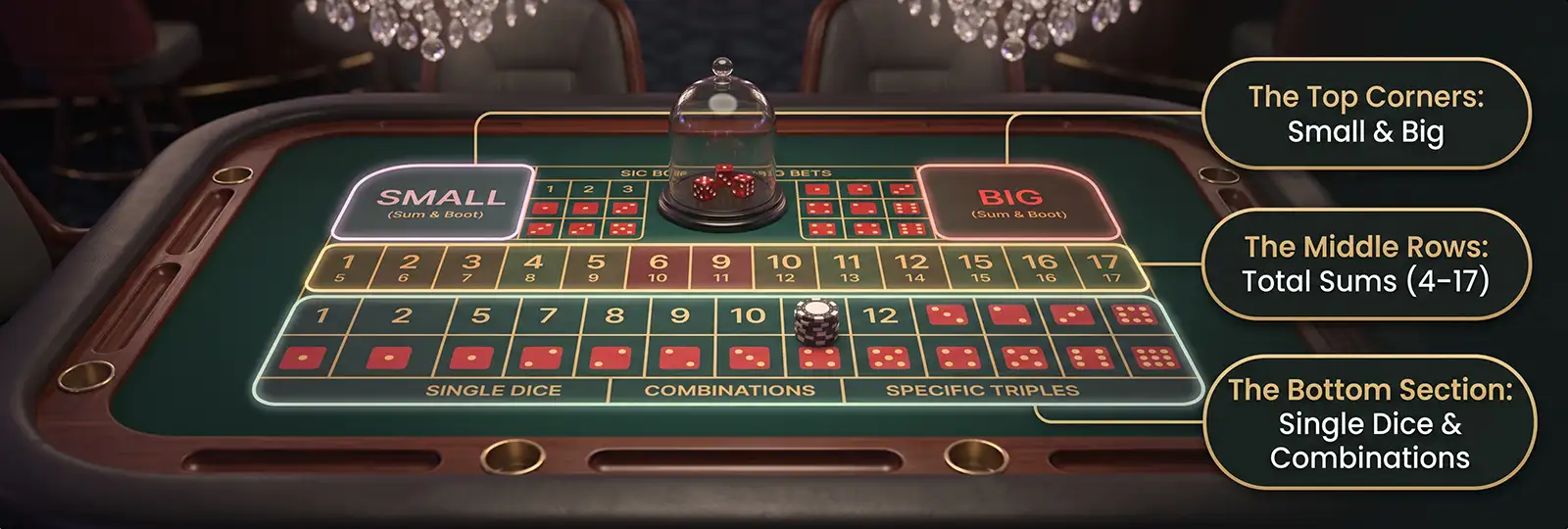
At first glance, a Sic Bo table can look crowded, but the layout follows a clear pattern. Betting areas are grouped by type. The top usually holds the broad options such as Small and Big, the middle focuses on total sums, and the bottom covers specific numbers, pairs, and combinations. Once you read it as a map of bet families rather than a wall of boxes, it becomes much easier to navigate.
The Top Corners: Small & Big
The top corners of the layout are usually reserved for Small and Big. These bets are based on the total of all three dice and offer a quick way to play without picking a specific number. Small covers totals 4–10, while Big covers 11–17. One detail matters straight away: 3 and 18 are not included, so the lowest and highest possible totals cannot win on Small or Big.
These areas are popular when you want a simple decision and a clear result after each roll. You are not trying to hit a precise combination; you are backing a range. That said, Small and Big come with a specific rule related to triples, which can catch beginners out.
The Middle Rows: Total Sums (4-17)
The middle rows are typically dedicated to betting on the specific total of all three dice. Here, you pick a specific sum from 4 to 17 and win if the roll adds up to that number. It is one of the easiest parts of the table to read, because every box is labelled with the total you are backing.
Compared with Small and Big, this is a more precise prediction. You are no longer covering a range, so you will hit less often, but the payout is higher when you do. It is also worth knowing that not all totals show up equally. Some sums can be made in many different ways with three dice, while others require far fewer combinations. That is why certain totals appear more regularly than you might expect, and others feel rare.
The Bottom Section: Single Dice & Combinations
The bottom section focuses on face-based bets, meaning you are betting on which numbers appear on the dice rather than the final total. You will usually see Single Dice options, where you choose a number from 1 to 6 and are paid depending on how many times it shows up, once, twice, or three times. It is a practical way to back a specific number without needing a specific three-dice combination.
Nearby, you will often find two-number combination bets. The idea is simple: select two different numbers, and you win if both appear in the same roll, in any order. Many layouts also include separate areas for specific pairs and for triples, but the purpose of this whole section is consistent. It is about matching specific faces, not predicting a total.




Rules and Flow of a Sic Bo Round
If you have just opened Sic Bo for the first time, the easiest way to settle in is to follow a single round from start to finish. You start by choosing your stake amount, then you place it onto the areas you want to cover, and after that you simply wait for the roll. Below is the standard sequence you will see in both live and RNG Sic Bo.
Bets open. A “bets open” status appears, and live tables usually show a countdown timer.
Choose your stake amount. Select a chip value or enter the amount you want to gamble.
Place the bet on the layout. Click the area you want, such as Small/Big, a specific total, a single number, or a combination.
Add extra bets if you want. Repeat steps 2–3 to cover multiple areas, as long as the table limits allow it.
Confirm your bets. Once confirmed, you cannot change them for that round.
The three dice roll. Live tables show the throw on camera, while RNG tables reveal it on screen.
Settlement and payout. Winning bets are paid at the odds shown on the table, and losing stakes are deducted. Notably, in the live format, if a die doesn’t come to rest flat on a face, the dealer invokes the cocked dice rule, and the dice are re-rolled.
Once you go through the whole process a few times in demo mode, you will naturally learn how to bet on Sic Bo, all without risking any real money.
The “Triple” Exception
A triple in Sic Bo is when all three dice show the same number, such as 2-2-2 or 5-5-5. For beginners, the key point is that, according to standard online Sic Bo rules, triples are usually treated as an exception for Small and Big. Even if the total falls within the covered range, the bet loses.
The triple rule in Sic Bo exists because Small and Big cover a wide spread of totals. Excluding triples stops these bets from being too all-purpose and helps protect casinos’ long-term profits.
Notably, triples are usually offered as their own bet on the layout, and they tend to pay far more than range bets when they hit.
Live Dealer vs. RNG Sic Bo

Online Sic Bo usually comes in two formats: live dealer and RNG. In live Sic Bo, you watch real dice being rolled in a studio via live stream. Rounds follow a steady rhythm with a clear betting timer, the roll, a visible result, and then settlement. This format suits players who like a table feel and the reassurance of seeing the dice land. You will also often get a live chat and an on-screen history of recent results.
RNG Sic Bo is built for speed. Each roll is generated by software, and the result is typically shown through a short dice animation. The betting window can feel tighter, with fewer pauses between rounds, which makes it easier to play more rounds in less time. RNG tables also tend to offer a wider spread of limits, so it is often simpler to find a low-stake option or a higher-limit table without hunting around.
The bet types and key Sic Bo rules, including triple exceptions, are the same. What changes are the presentation, the pace, and the overall casino experience.
Common Mistakes
Most beginner mistakes in Sic Bo are not about bad luck; they’re about misreading a bet or rushing the round. A few slip-ups feel reasonable until you see the settlement on screen, especially in live games where the timer pushes you along. Below are three common situations that cause avoidable losses and frustration, and they are easy to fix once you know what to watch for.
Betting Big and Small Together
Some beginners bet on both Big and Small because it seems like there is a way to consistently earn money. Part of that thinking is true: most rolls do land in one of the two ranges, so one of your bets will usually win. The catch is that the other bet loses, so if you stake the same amount on both, you get no profit even when the roll is not a triple.
The next step newbies take is to make the bets different, such as $10 on Big and $5 on Small, with the idea that the smaller bet cushions losses while the bigger bet generates profit. In practice, even before triples come into play, you win or lose only the difference. If Big wins, you net $5. If Small wins, you lose $5. That is basically the same as betting $5 on one side, but you’re staking more total money to get the same winnings. Any triple makes both bets lose, so you can lose $15 in one roll and quickly deplete your bankroll.
Confusion around “Double” and “Pair”
Sic Bo layouts can label the same type of bet differently, such as “Specific Double” or “Specific Pair,” and the names are easy to mix up. In both cases, it’s a bet on a matching pair, such as 4-4, and it pays if at least two dice show that number, with some tables also counting the matching triple (4-4-4) as a win. Sic Bo tables can also offer an Any Double or Any Pair option, which is broader, because it pays on any matching pair. Regardless of the label, checking the paytable before staking real money is always a good habit.
Ignoring the Timer
On live tables, the timer is not just a decoration. If you ignore it, you can miss the chance to confirm your bet or leave something on the layout that you did not mean to play. The most common scenario is selecting a chip, clicking a bet area, then failing to hit confirm before betting closes. To avoid it, choose your stake first, place it second, and always check that the bet has actually been accepted.
Conclusion
In our opinion, Sic Bo does not click for everyone straight away, and that is fair. The rules of Sic Bo are simple on paper, but the layout often feels busy. There are many betting areas, similar-sounding options, and different Sic Bo game rules, which can put new players off. Because of that, the game tends to suit people who enjoy a format with lots of possible outcomes and like choosing between broad coverage bets and more precise targets with higher payouts.
If you do want to give it a proper try, the best approach is to simplify the start. Stick to one bet family, such as Small/Big or totals, and play a few rounds in demo mode until the interface feels familiar. Once you are familiar with everything and are ready to start playing for real money, choose a licensed and reputable online casino, don’t forget about responsible gambling practices, and have fun.
FAQs
What Happens If The Dice Land On Top Of Each Other?
If dice land stacked or touching, the result counts only if each die is clearly resting flat on a face, and its top value is visible. If any die is tilted or unclear, the dealer applies the cocked dice rule and re-rolls. In RNG Sic Bo, stacking isn’t an issue because outcomes are generated digitally.
Why Did I Lose My “Big” Bet On Three 6s?
There are two reasons. First, on most Sic Bo live casino tables, all triples make both Big and Small bets lose. In this case, the total is also 18, while Big only covers 11–17.
Can I Bet On Multiple Outcomes At Once?
Yes, you can usually cover multiple areas in the same round, for example, Small plus a specific total, or a single number plus a combination. The limits depend on the Sic Bo casino rules and the maximum allowed on each betting area. Just make sure everything is confirmed before betting closes.
How Much Time Do I Have To Bet In Live Sic Bo?
In live Sic Bo, your betting time is set by the on-screen countdown. It is usually a short window before the roll, designed to give players enough time to choose chips and confirm bets. Watch the timer and avoid leaving confirmation to the last seconds.