







Unlike other popular games, Blackjack is not just about luck. It is also about mathematics and discipline. You sit at a virtual table, place a wager, and try to reduce the house edge. Unlike slots, where you just press a button, blackjack requires you to make decisions that directly impact your wallet.
New players often get confused by the speed of online play. They panic when the timer counts down. They click the wrong buttons. This Blackjack guide cuts through the noise. We will strip away the confusion and focus strictly on the mechanics, the blackjack game rules, and the correct moves to make. You don’t need a “feeling” or flashy casino bonuses. You need a plan.
The Objective: Beat the Dealer
Most beginners think the goal is to get a hand value of 21. That is false. Unlike roulette games where the outcome is purely luck-based once the wheel spins, here your in-game choices matter. Your only objective is to beat the dealer. You can win with a 12 if the dealer busts. You can lose with a 20 if the dealer draws a 21.
Ignore the other players at the table. In a live dealer environment, their cards might irritate you, but they do not change your mathematical odds. It is a duel between your hand and the dealer’s hand. If you finish with a higher total than them without going over 21, you are one step closer to making a withdrawal. If you tie, nobody wins. If you go over, the house takes your chips.
How to Win (3 Ways)
Winning comes down to three specific scenarios. Understanding these helps you manage your bankroll effectively.
- Higher Value: Your hand total is higher than the dealer’s total, and neither of you exceeds 21.
- Dealer Busts: You remain in the game (you didn’t bust), and the dealer hits according to table rules (typically until 17) and goes over 21. This is the most satisfying way to win.
- Natural Blackjack: Your first two cards are an Ace and a 10-value card (10, Jack, Queen, King). This is the best hand possible. It usually pays out at 3:2 odds, meaning you get more money than a standard win.
Card Values Cheat Sheet
You cannot play if you cannot calculate hand value. Fortunately, the suits (hearts, diamonds, clubs, spades) are irrelevant in standard variations. You only care about the numerical value.
| Card | Value | Note |
|---|---|---|
| 2 through 9 | Face Value | A 5 is worth 5. A 9 is worth 9. Simple. |
| 10, J, Q, K | 10 | These are the most common values in the deck. |
| Ace | 1 or 11 | The “shapeshifter”. It counts as 11 unless that busts you, then it becomes a 1. |
Game Interface (Controls)
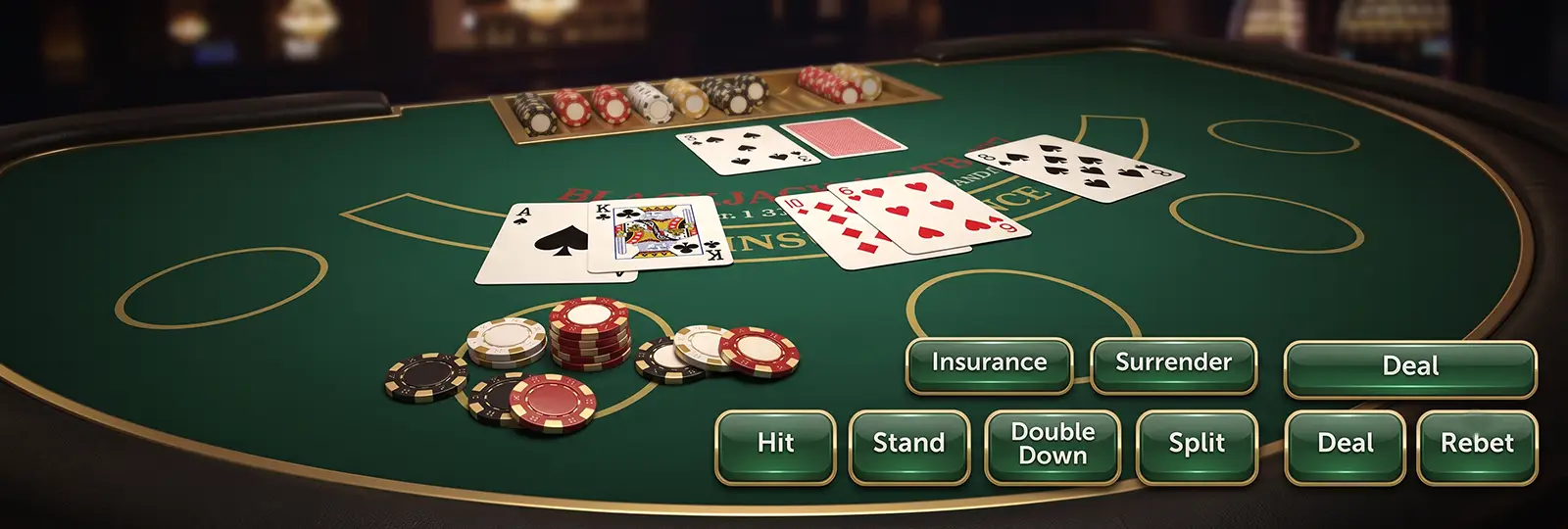
Every gambling site uses specific buttons that differ slightly from the hand signals you’d use at a physical table. Mastering the interface improves your overall casino experience and prevents expensive misclicks.
“Deal” / “Rebet” Buttons
The “Deal” button locks in your chips and starts the round. Once clicked, you cannot take the money back. The “Rebet” button is a convenience tool. It places the exact same wager as the previous round. Be careful with this if you just lost a large chunk of your balance.
“Hit” (Take Card)
Clicking “Hit” asks the dealer for another card. You can hit as many times as you like, provided you do not go over 21. Use this when your total is low or you believe the dealer has a strong hand.
“Stand” (Hold)
“Stand” means you are finished. You are happy with your total (or afraid to bust) and pass the turn to the dealer. Once you stand, you cannot change your mind.
“Double Down” (x2 Bet)
This is an aggressive move. You double your initial bet in exchange for receiving exactly one more card. Any serious Blackjack guide prioritises this move. You usually do this when you have a total of 10 or 11. Statistically, about 31% of the deck consists of 10-value cards. When you hold an 11, you have a high probability of landing a 21. Doubling allows you to capitalise on the dealer’s weakness. Failing to double in these mathematical sweet spots increases the house edge against you. It increases volatility, so use it only in the right situations.
“Split” (Divide Pairs)
If you are dealt a pair of cards (like two 8s), you can split them. You must place a second bet equal to the first. The hand separates into two individual hands, and you play them separately. Never split 10s. Always split Aces. A pair of 10s equals 20, the second-best hand in the game. Splitting them drastically lowers your win probability. Conversely, two 8s equal 16, the worst starting hand. Splitting gives you a mathematical fighting chance.
“Insurance” / “Surrender”
Insurance is offered when the dealer shows an Ace. It pays 2:1 if the dealer has Blackjack. Do not take it. It is a bad bet mathematically. Surrender allows you to fold a terrible hand and get half your bet back. If the casino offers surrender, use it wisely.




Walkthrough of a Round
Here is exactly what happens from the moment you join a table to the payout.
Place Your Bet
You select a chip value and place it on the table circle. Check the table limits first.
The Deal
You receive two cards face up. The dealer receives one card face up and one face down (the “hole” card).
Your Decision
You analyse your cards against the dealer’s visible card. You choose to Hit, Stand, Double, or Split.
Dealer’s Turn
Once you stand or bust, the dealer reveals their hole card. They must follow strict rules (usually hitting until they reach 17).
Settlement
The software compares totals. Winnings are credited to your account instantly.
Key Table Rules
Not all blackjack games are created equal. Casinos tweak rules to increase their edge. Read the “Info” tab before you sit down.
“Blackjack Pays 3:2” vs “6:5”
This is the most critical rule. A standard table pays 3:2 for a natural blackjack (bet 10, win 15). Many “party” pits or low-limit online tables pay 6:5 (bet 10, win 12). Avoid 6:5 tables. The maths is simple but brutal. On a $100 bet, a 3:2 table pays $150. A 6:5 table pays only $120. That $30 difference adds up. A 6:5 rule increases the house edge by roughly 1.4%, making it nearly impossible to win long-term. They dramatically increase the casino’s advantage over time.
“Dealer Must Stand on 17”
In some games, the dealer stands on a “Soft 17” (Ace + 6). In others, they must hit. A rule requiring the dealer to stand on all 17s is better for the player. It forces the dealer to stop drawing, limiting their chance to improve a mediocre hand.
Table Limits (Min/Max Bet)
Every table has a floor and a ceiling. The minimum might be $1 or $5. The maximum could be $5,000. Ensure your deposit covers at least 20–30 rounds at the minimum bet. If you have $50, do not sit at a $25 table. You will be broke in two minutes.
Mistakes with the Interface

Online gaming introduces technical errors that don’t exist in land-based casinos. A simple lag or misclick can burn through your first deposit faster than a bad run of cards.
Timing Out
Live dealer games have a shot clock. Unlike playing free spins on slots where you can pause and grab a coffee, here you must act instantly. If you do not act within 10–15 seconds, the system usually defaults to “Stand”. If you had 11 and needed to double, this auto-stand costs you money.
Clicking “Hit” instead of “Stand”
Speed kills your bankroll. On mobile devices, the action buttons are tightly packed. This isn’t just a mobile issue, though. Even on a desktop, a careless mouse click turns a winning hand into a bust. One slip deletes your wager instantly. Do not rush. Always take a moment to look before you act. Customer support will rarely refund user errors.
Misunderstanding “Insurance”
New players see “Insurance” and think it sounds safe. It is a trap. The casino is betting that the dealer has a 10 in the hole. The odds do not justify the price. Ignore the flashing button.
Conclusion
Learning how to play blackjack is the easy part. Sticking to the strategy when you are losing is the hard part. The game offers one of the best return-to-player percentages in the online casino, but only if you follow the rules of blackjack rigidly. Treat your bankroll with respect. Don’t chase losses, and never play with money you need for rent.
FAQs
Is It Difficult To Learn How To Play Blackjack For A Beginner?
No. Compared to other table games, the mechanics here are simple. You can learn the core moves (Hit, Stand) in five minutes. It is the most logical casino game for a starter. However, mastering the optimal strategy takes practice. Use a “cheat sheet” while you play at an online casino until you memorise the patterns.
What Are The Most Important Blackjack Game Rules To Remember?
Always check the payout ratio. If it is 6:5, leave. That rule destroys your winning chances. Remember that the dealer must play by fixed rules and cannot make choices like you can. Also, proper responsible gambling involves setting deposit limits before you sit down. A “Push” saves your money, it is not a loss.
Do Online Blackjack Rules Differ From Live Casinos?
Generally, the rules are the same, but online RNG (virtual) games shuffle the deck after every single hand. This makes card counting impossible. Live dealer streams function like physical casinos, with a shoe of cards that is shuffled periodically.
Is There A Specific Blackjack Strategy To Help Me Win?
Yes. It is called “Basic Strategy”. It is a mathematical chart that tells you exactly what to do for every possible card combination. These charts are based on millions of computer simulations. For instance, basic strategy dictates you always hit a hard 12 against a dealer’s 2 or 3. It might feel wrong, but the data proves it loses less money than standing. Following this strategy reduces the house edge to under 0.5%. It does not guarantee winning every hand, but it minimises losses over the long run.