







Blackjack Card Values Explained
Every online or live blackjack hand boils down to basic arithmetic. Card values are fixed by rule rather than suit, shaping every decision you make at the table. Number cards count at face value, face cards are worth 10, and the Ace operates as either 1 or 11 depending on what helps your total most.
Understanding Blackjack Card Values at a Glance
Blackjack scoring rests on a short, fixed list. Suit and color never factor into a card’s worth: a red 8 and a black 8 play identically. These values hold whether you sit at a land-based table, play a European layout, or wager online at platforms like Casino.net. Only standard table rules like payouts, deck counts, and dealer restrictions vary between games. Two card types demand extra attention: face cards (always worth 10) and the Ace (shifting between 1 and 11).
| Card | Value in Blackjack |
|---|---|
| 2–9 | Face value |
| 10 | 10 |
| Jack | 10 |
| Queen | 10 |
| King | 10 |
| Ace | 1 or 11 |
How to Calculate Your Hand Value
Calculating a hand total requires summing the point value of each card. When an Ace is present, the game counts it as 11 unless that pushes the total past 21, in which case it reverts to 1.




Face Cards: Jack, Queen, and King
Jacks, Queens, and Kings all carry a value of 10. Because blackjack defines matching pairs by point value, a King and a Queen qualify for splitting just like a pair of Kings, though basic strategy rarely recommends doing so. Recognising that all three face cards function identically opens up pairing options that beginners miss, while explaining why 10-value cards dominate the deck.
The Ace: Blackjack’s Most Flexible Card
The Ace is the most versatile card in the deck, counting as either 1 or 11. That flexibility enables a Natural Blackjack: an Ace paired with a 10-value card forms an unbeatable starting total of 21, which traditionally pays 3:2. For example, if you hold an Ace and a King against a dealer showing a 6 up-card, your total is 21 immediately. Unless the dealer also holds a blackjack (resulting in a push), you collect the payout straight away.
Calculating Your Hand Total: Soft vs. Hard Hands
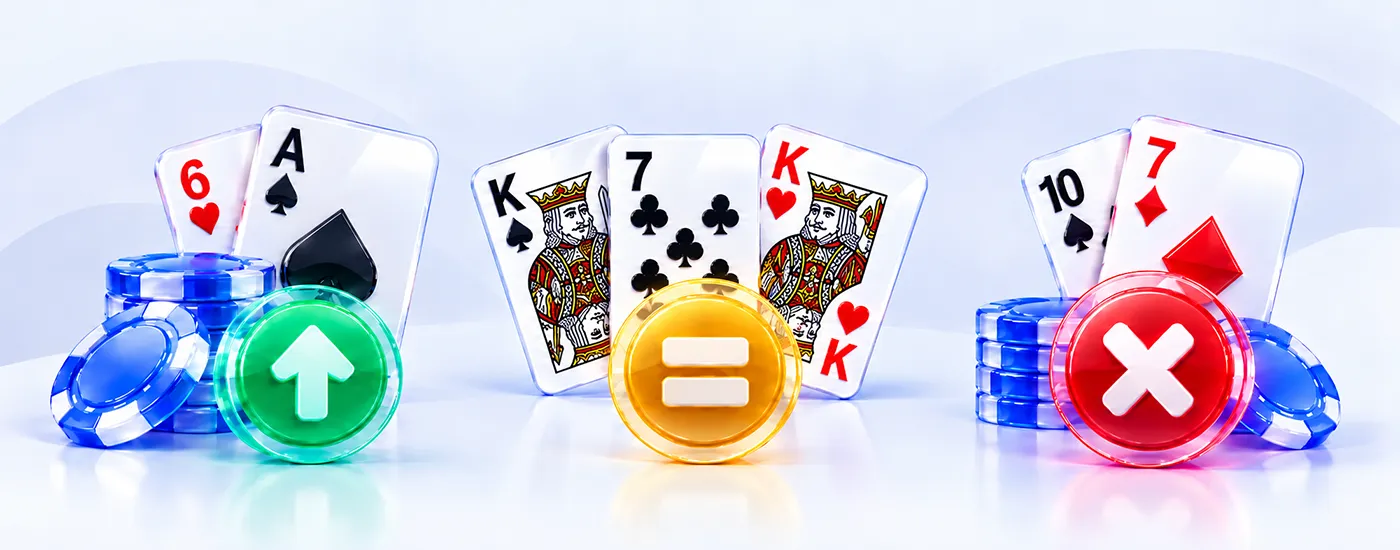
Adding up a blackjack hand is straightforward once you separate soft hands from hard ones. A soft hand includes an Ace counted as 11 without busting, such as an Ace and 6 totaling a soft 17. A hard hand either has no Ace or forces the Ace to count as 1 to avoid going over 21. A 10 and a 7 make a hard 17, offering no flexibility. Similarly, a hand of King, 6, and 5 locks in at a hard 21 because the total leaves no room for an Ace to count as 11. This distinction is critical for dealer rules: many tables require the dealer to hit on soft 17, which slightly increases the house edge.
Push
A push is a tie between player and dealer when both hands finish with the same value. When this happens, your original stake is returned and no money changes hands.
Bust
A bust occurs whenever a hand exceeds 21 points, resulting in an immediate loss regardless of the dealer’s final total. If you hold a hard 16 and draw a 7, your total becomes 23 and the dealer collects your stake instantly.
Common Mistakes with Card Values
Several common errors trip up new players at the table:
Why Card Values Matter for Strategy and Card Counting
Understanding card values is necessary for applying basic strategy. As a general rule, players stand on hard totals of 17 or higher, hit on 12 through 16 when the dealer shows a 7 or higher, and double down or split when the dealer shows weakness. Card counting expands on these fundamental values by tracking the ratio of high cards (10s and Aces) to low cards remaining in the deck, helping players calculate when the shoe favours the bettor.
Basic Strategy Examples Using Card Values
Basic strategy provides a mathematically optimal way to play any hand. Here are a few foundational rules based on card values:

Frequently Asked Questions
How much is an Ace worth in blackjack?
An Ace counts as either 1 or 11, depending on which value benefits the hand. This dual value enables soft hands and forms a Natural Blackjack when paired with a 10-value card.
How much are face cards worth in blackjack?
Jacks, Queens, and Kings are worth 10 points each. Suit and rank do not alter their scoring value or affect splitting rules.
What is the difference between a hard hand and a soft hand?
A soft hand contains an Ace valued at 11 without pushing the total over 21. A hard hand either contains no Ace or forces the Ace to count as 1 to avoid busting.
How do you calculate your hand total in blackjack?
Add together the point value of each card in your hand: number cards at face value, face cards at 10, and Aces at 1 or 11. Select the Ace value that brings the hand total closest to 21 without exceeding it.
Do card suits matter in blackjack?
No, suits have no effect on card values or gameplay in standard blackjack. A 10 of hearts holds the exact same value as a 10 of spades, as hand calculations depend entirely on point values.
Does a 21 after splitting pairs count as a blackjack?
No. If you split a pair (like two Aces) and then draw a 10-value card to one of them, the resulting hand total is 21, but it is not considered a “Natural Blackjack.” It is treated as a standard 21 and pays out at 1:1, not the typical 3:2 bonus. A Natural Blackjack can only be achieved with the first two cards dealt.