








In today’s gambling world, players often want to try something new. One day it is slots, the next you are eyeing up blackjack or poker, and then baccarat pops up and you think, “Rules, bets, strange tables… where do I start?” For beginners, the real hurdle is often simple: you do not want to make a mistake before the first hand even begins because the buttons look unfamiliar, the scoring is unclear, and the third card seems to appear for reasons you cannot see.
This page is for anyone who wants to get comfortable with baccarat quickly, without wading through unnecessary theory. Baccarat is a casino card game where you do not make decisions about drawing cards. Instead, you bet on the outcome of a round: the Player hand wins, the Banker hand wins, or the result is a Tie. The rest runs on fixed Baccarat rules, so your job is mainly choosing a bet and understanding the scoring.
Below, you will learn the goal of the game, how to play baccarat, card values and points, how an online table is laid out, and how a hand plays out step by step. You’ll also find what the “third card rule” means, plus key notes on commission and the difference between live dealer and RNG games.
The Goal: Betting on the Winner
The baccarat casino game has a very straightforward aim: predict which hand will finish closest to 9 at the end of the round. The table always has two sides, Player and Banker. These are not “you versus the online casino” in the usual sense. They are simply two hands you can back. You can also bet on a Tie if you think both sides will land on the same total.
A round starts with your wager. Each side is dealt two cards, and the points are counted straight away. If either hand totals 8 or 9 from those first two cards, it is a “natural”, and the round will normally end without any further draw. If the totals are lower, a third card may be dealt, but you do not decide that. Drawing follows fixed rules, which is why baccarat feels easy to settle into after only a few rounds.
The key thing to remember is this: you are not building combinations like poker, and you are not choosing hits like blackjack. You are simply picking an outcome and letting the rules of Baccarat take the hand to its result.
Baccarat Card Values
Card values in baccarat are simpler than they first look because only the points total matters. Suits do not matter, and there are no poker-style hands. Cards 2 to 9 are worth their face value. An Ace is worth 1. 10s, Jacks, Queens, and Kings are worth 0.
The crucial scoring rule is “mod 10” counting. If your two or three cards add up to 10 or more, you only keep the last digit. For example, 7 + 6 = 13, so the hand totals 3. 9 + 8 = 17, so it totals 7. This rule applies every time, which is why baccarat hands can only land between 0 and 9.
This is also what can confuse newcomers at first. A hand that looks “bigger” in normal arithmetic can effectively be smaller once you drop the tens digit. If Player has 9 + 7 = 16, that is 6 points. If Banker has 8 + 8 = 16, that is also 6, which makes it a Tie. Once you get used to “keep the last digit only”, scoring becomes quick, and you can focus on your bets.
The Game Interface: Buttons & Layout

An online baccarat table can look busy at first, especially in live dealer games where you also see scoreboards running down the side. In reality, most layouts are consistent and easy to read once you know what you are looking at. The centre is reserved for betting areas, the side panels show recent results, and the bottom section typically contains the round controls. Next, we will break down where you place bets, what the roadmaps mean, and what the key buttons do.
Betting Areas
Betting areas sit in the middle of the table and are usually split into three main sections: Player, Banker, and Tie. These are your core options. You select the area, pick a chip value, and place the wager before the deal starts. Most tables also show the payout terms nearby, so you can see what a winning bet returns at a glance.
Many casino games add side bets such as Player Pair or Banker Pair. These cover specific events inside the hand, like the first two cards matching in rank, and they do not affect which side wins on points. For a first run at baccarat, it is sensible to focus on the three main betting areas and get comfortable spotting them quickly.
In live dealer baccarat, the betting areas work the same way. The main difference is pacing: you will usually see a clear betting timer, so you need to place your chips before bets close.
The “Roadmaps” (Scoreboards)
Roadmaps, sometimes labelled as scoreboards, display the outcomes of previous rounds. Their job is simple: give you a clear history so you do not have to track results in your head. The easiest one to read shows the winner of each hand: Banker, Player, or Tie. Banker and Player are often colour-coded, while ties are marked with a separate symbol.
You may also see extra boards that organise the same results into different patterns, often designed to make streaks and repeats easier to spot. For new players, it helps to treat these as a tracking tool rather than a hint of what comes next. Roadmaps do not change the odds of the next hand, but they do make it easier to follow the flow of play and pick up where you left off if you glance away.
Deal / Rebet / Clear
Deal, Rebet, and Clear are the core control buttons you will see on most online baccarat tables. In RNG games, clicking Deal once you have placed your chips starts the hand. In a baccarat live casino, the round is often driven by a betting timer, but the bet controls still work in a similar way.
Rebet repeats your last wager, or a set of wagers, for the next round with a single click. It is useful if you are playing the same stake and do not want to rebuild your bet each time. If betting has already closed, Rebet will only apply in the next betting window.
Clear removes the chips you have placed for the current round while bets are still open. It is the quick way to fix a mis-click or undo a late change of mind. Once bets close, Clear is disabled, so it helps to check your selected areas early.




How to Play a Baccarat Hand
If you are new to baccarat, the quickest way to feel comfortable is to understand a single round from start to finish. A clear step-by-step run-through helps you keep up with the pace, recognise what the table is doing, and avoid getting stuck on small details. Below is a short Baccarat guide designed for a smooth first session, from placing a bet to settling the result.
Place your bet:
Before the round begins, put your chips on Player, Banker, or Tie (plus any side bets if you are using them). In live games, watch the timer. In RNG versions, the hand starts after you click Deal.
Two cards are dealt:
Both Player and Banker receive two cards. The total is counted immediately using baccarat scoring, keeping only the last digit of the sum.
Check for a natural:
If either hand totals 8 or 9 on the first two cards, the round will normally end there.
Third card draw:
If there is no natural, a third card may be dealt to one or both hands. This follows fixed online baccarat rules, with no decisions required from you.
Result and payout:
The final totals are compared. The hand closest to 9 wins. If the totals match, the result is a Tie. Your bet is settled, and you are ready for the next round.
“Third Card Rule”
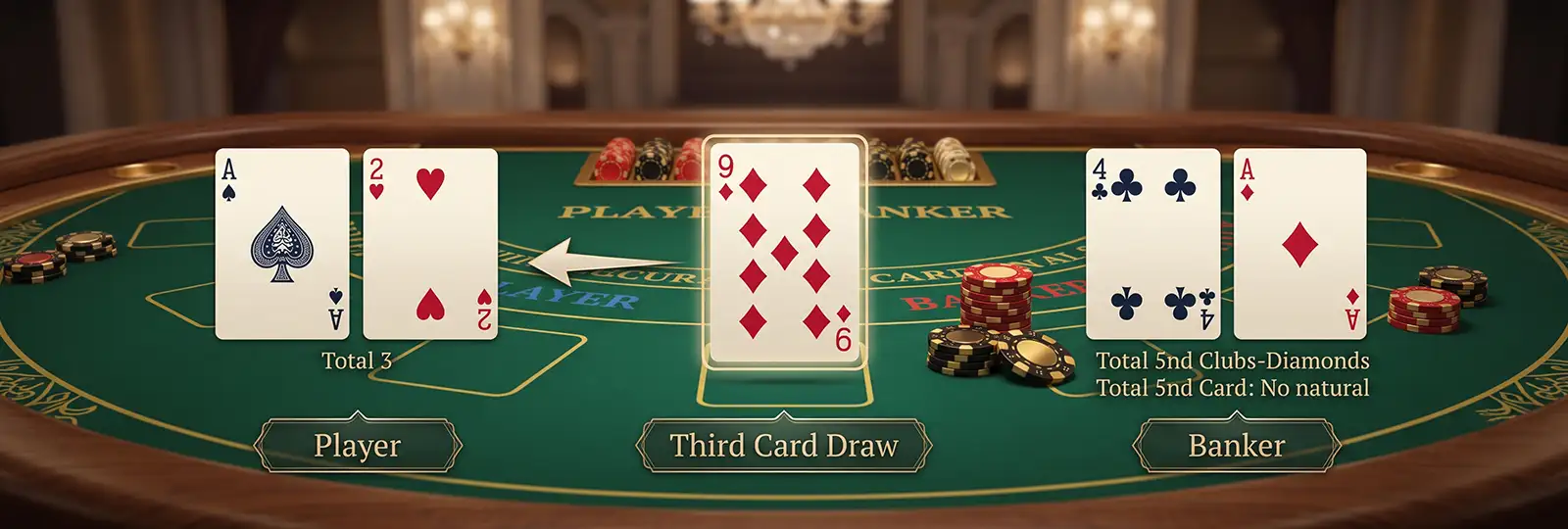
The Third Card Rule is the fixed set of draw rules that decides whether the Player or the Banker receives one additional card. You do not choose to take a card, and there is no “hit” decision. The game applies the draw conditions automatically, so each hand reaches a valid final total. The useful headline is simple: Player has shorter draw conditions, while Banker’s draw depends on its own total and on Player’s third card, if one is dealt.
When Does The Player Draw?
The Player draw rule is the shortest one and tends to make sense quickly. After the first two cards, the total is checked. If the Player total is 0–5, a third card is drawn. If it is 6–7, the Player stands. Totals of 8 or 9 are naturals, and the hand will normally end immediately with no third cards at all.
In other words, the Player is driven by a single threshold: 5 or lower draws; 6 or higher stands. This decision does not depend on what Banker is holding. The Player’s action is resolved first, and then, if needed, the game applies the Banker’s draw conditions based on the Banker’s total and the Player’s third card.
When Does The Banker Draw?
Banker’s draw depends on the Banker’s total and on what happened on the Player side. If Player stands on 6–7, it is simple: Banker draws on 0–5 and stands on 6–7. If the Player draws a third card, the Banker follows this list:
- 0–2: always draws;
- 3: draws, except when Player’s third card is 8;
- 4: draws if Player’s third card is 2–7;
- 5: draws if Player’s third card is 4–7;
- 6: draws if Player’s third card is 6–7;
- 7: does not draw.
If either side has a natural 8 or 9 from the first two cards, no one draws, and the round ends immediately.
Why You Don’t Need To Memorise This
It helps to understand the draw logic so the third card never feels random, but you do not need to memorise the chart. In online baccarat, you cannot influence the draw, and the game applies the same rules automatically every round. It is more useful to focus on scoring, bet selection, and keeping your stake sizes under control.
Betting Mechanics
In baccarat, you bet on one of three outcomes: Banker, Player, or Tie. You place your wager before the deal, and it locks in when betting closes. The hand runs automatically, and the payout depends on the outcome you chose. Player and Banker are the core bets. Ties pay more, but they happen less often. Here is what is helpful to know:
Banker Commission
In many baccarat versions, the Banker’s win is paid with a commission. The classic rate is 5%: when the Banker wins, the house keeps 5% of the profit and pays the rest to the player. The commission exists because the Banker has a small built-in edge under the drawing Baccarat game rules. Some tables use alternative payout formats instead of a commission, but the idea is the same: the Banker is often not paid as a clean 1:1.
Tie Bet Risk
A Tie bet looks attractive because the payout is higher, but the risk is that ties land far less frequently than Player or Banker wins. Close calls do not count. Either the totals match or the bet loses. Tie can make sense as an occasional extra, but as a main bet it is more likely to create sharp swings in your bankroll.
Live Dealer vs. RNG Baccarat

Online baccarat comes in two formats: live dealer and RNG. In live games, a real dealer runs the table on camera and you place bets through an interface with a visible timer. This format suits players who want a more traditional feel, with physical cards on screen and a steadier rhythm between rounds.
In RNG baccarat, cards are generated by software and rounds move faster. It is a practical option for shorter sessions, getting comfortable with scoring, or playing without waiting for the dealer’s pace. The Baccarat casino rules and scoring are the same in both formats. The differences are usually speed, presentation, and table settings such as betting limits and the selection of side bets.
Conclusion
Baccarat is a solid entry point for anyone who wants to try a table game without learning a long list of decisions. You are not choosing draws. You are learning the goal, the card values, and the scoring method. Once you are comfortable with the “last digit only” total and the difference between Player, Banker, and Tie bets, the game becomes easy to follow and consistent in how a round plays out.
On the practical side, most beginners do best by sticking to the main bets and treating roadmaps as a history tool, not a prediction system. They help you track what happened, but they do not give you an edge on the next hand. Pick the pace that suits you, live or RNG, and keep your stakes sensible. That is how baccarat stays a calm, readable game instead of a chase.
FAQs
What Is Baccarat?
Baccarat is a game where you do not build hands or decide to take cards. You simply bet on the result: Player wins, Banker wins, or it is a Tie. The cards are dealt automatically, and the winner is the side with a total closest to 9.
What Is A “Natural” In Baccarat?
A “natural” is when the Player or Banker totals 8 or 9 from the first two cards. The round will normally end immediately, no third cards are drawn, and the winner is decided on those two-card totals.
What Counts As 0 In Baccarat?
In baccarat, 10s and all face cards count as 0: 10, Jack, Queen, and King. A hand total can also become 0 through mod 10 scoring, for example, 8 + 2 = 10, which totals 0.
Why Did The Banker Win With Fewer Cards?
In baccarat, the winner is decided by the final points total from 0 to 9, not by how many cards were used. Banker may stay on two cards because the draw rules require it, and still finish with a higher total than Player even after Player draws a third card.