





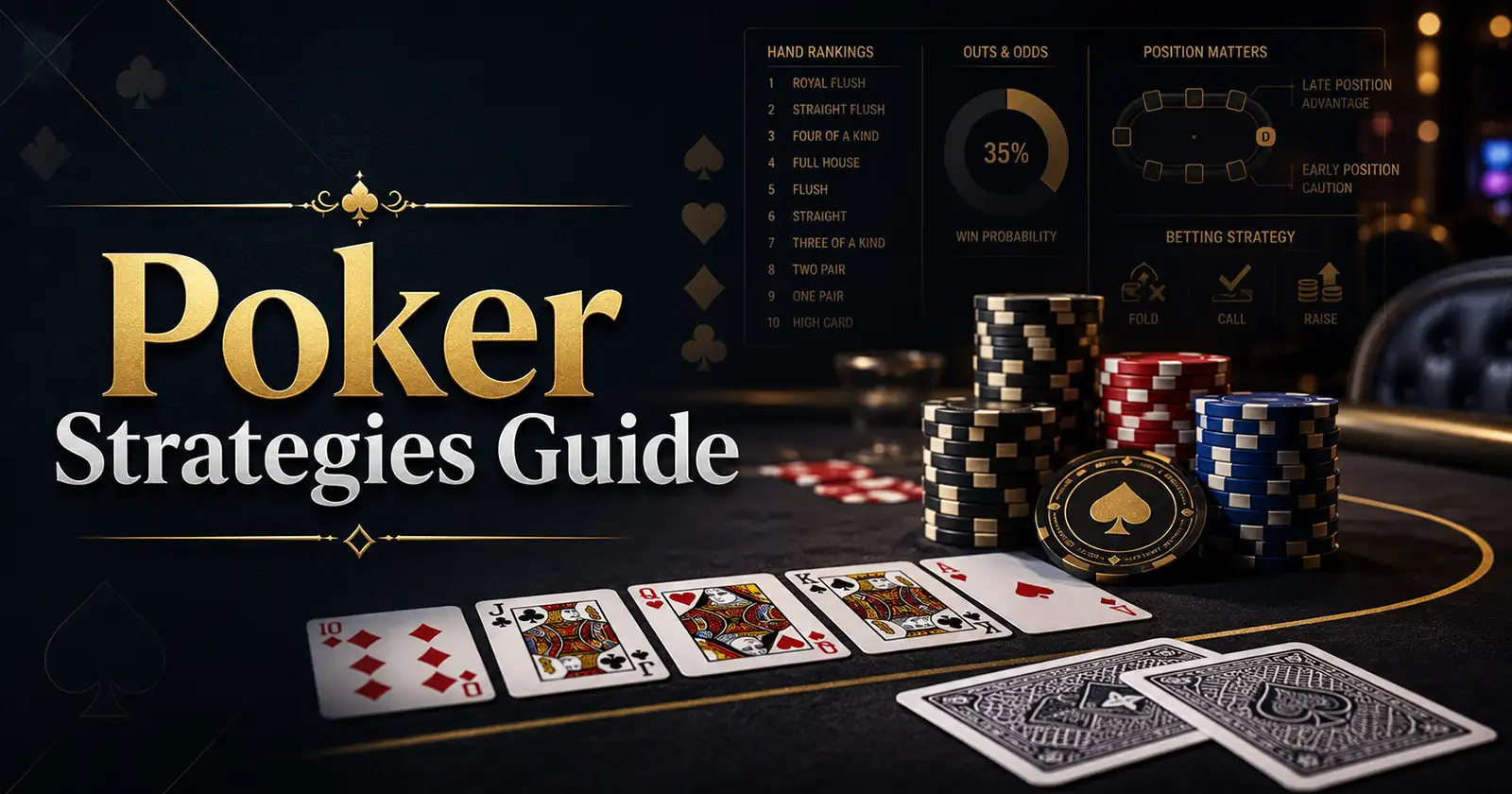

Mastering poker strategies begins with solid fundamentals and then develops into structured systems that perform under pressure. This guide explains basic poker strategies, the maths behind decisions, and table dynamics so you can follow a clear plan instead of guessing each hand. It covers online poker strategies and emphasises habits that reduce mistakes relative to your edges. The material suits poker strategies for beginners while also signalling directions for more advanced study.
Core Concepts: Basic Poker Strategies
Every strong approach starts with a few basic poker strategies that shape how you sit at the table, which hands you pick, and how you put money into the pot. These ideas do not require complex maths, but they influence every street and every pot you enter.
The Power of Position
Position decides who acts first and who acts last, which controls how much information you see before putting chips in. Sitting near the end of the betting order lets you watch opponents act, see whether the pot is contested, and judge how strong ranges look before you commit. Acting last also makes it easier to keep pots small with medium strength hands or build big pots with value.
A simple way to remember things is to group seats into three blocks:
| Table seats | Description | Typical goal |
|---|---|---|
| Early | Seats under the gun and two players after it | Tight selection and fewer speculative hands |
| Middle | Seats that act after early positions but before late ones | Mix of value and playable speculative hands |
| Late | The Button / Cutoff and the blinds | Wider selection, pressure on tighter players |
The Button / Cutoff benefit from acting last post flop in most hands, which gives these seats freedom to raise more preflop, steal blinds and barrel scare cards. The players in the Big Blind / Small Blind act first after the flop in single-raised pots, so they need stronger holdings to continue and a tighter defence plan. Building your game around strong late position habits is one of the fastest shortcuts to better results. In standard formats, the dealer button moves clockwise, so every seat enjoys a late position the same number of times over a long session.
Aggression vs. Passivity
Aggression in this context means betting and raising, while passivity means a lot of checking and calling. Aggressive play gives you two ways to win pots: either by holding the best hand or by forcing folds. Passive play mostly wins only when you show down the best hand, and puts you in tough spots facing bets on later streets.
A Tight-Aggressive (TAG) style plays fewer hands but attacks hard with them, turning position and initiative into pressure. A Loose-Aggressive (LAG) style plays more starting hands and uses frequent raises to put opponents in difficult spots. Both styles beat passive calling when they follow a clear plan for board textures and stack sizes. When you feel lost on a street, defaulting to fold instead of a hopeful call protects your bankroll and keeps your decisions clean.
Starting Hand Selection (Ranges)
A strong pre-flop plan begins with selecting the right starting hands based on your position and table dynamics. Rather than evaluating cards in isolation, skilled players group hands into ranges, which are structured sets of combinations they are willing to play from each seat. These hand ranges evolve depending on the stage of a hand and the tendencies of opponents.
The core of any successful poker strategy lies in understanding how ranges interact. For instance, tighter ranges from early positions reduce risk and protect your stack. Wider ranges on the Button or in the Cutoff let you apply pressure, exploit fold equity, and steal blinds more effectively. This balance is especially important in No Limit Holdem, where positional advantage is critical.
Beginners should start with around 15–20% of hands from early position, expanding to 25–40% from late position. A good Texas Holdem strategy means combining premium pairs, suited broadways, and strong suited connectors to create flexible pre-flop decisions.
Mastering starting hand selection improves your win rate, reduces mistakes, and helps maintain consistency across cash games, poker tournaments (MTT) and multi-table sessions in any online poker room. With discipline and structure, building optimal ranges becomes second nature and forms a key part of all advanced poker strategies.
Poker Betting Strategies & Mathematics

Once you understand which hands to play and from where, the next step is using maths to decide whether money should go into the pot. Poker betting strategies rest on simple ratios that measure the price of a call against the value of your draw or made hand. None of these ideas requires complex equations, but they do require consistent use.
Understanding Pot Odds
Pot odds describe the ratio between the current pot and the cost of a call. If the pot holds $30 and your opponent bets $10, you are calling $10 to win $40, which equals odds of four to one. To make a profitable call with a drawing hand, your chance to hit by the next card needs to be higher than the break-even percentage implied by those odds. In this example, four to one converts to 20 percent, so your draw needs at least that much chance to improve for the decision to break even or better.
Implied Odds
Implied odds extend the same idea by including money you expect to win on future streets. A call on the flop can be correct even when straight or flush odds alone do not justify it if you think a strong made hand will earn more bets on the turn and river. For example, when you call $10 in a $30 pot with a flush draw and expect to win an extra $20 on later streets when you hit, your real risk and reward change. Implied odds help you call profitably against opponents who pay off big hands too many times.
Bet Sizing Strategy
Bet size shapes how ranges interact. Small bets apply light pressure and keep opponent ranges wide, which is useful with thin value hands and cheap bluffs. Medium bets attack capped ranges and force more folds from weak pairs and draws. Larger bets challenge strong hands and work best when stacks are deep, and you are willing to put in a big share of your stack.
A simple bet sizing framework for single-raised pots can be expressed as follows:
- Dry boards where your range has a clear advantage. Small bets in the region of 25–35% of the pot apply controlled pressure, keep weaker hands involved, and limit risk when bluffing with marginal holdings.
- Wet boards containing multiple draws. Medium bets of roughly 50–75% of the pot are used to charge drawing hands properly and protect made hands against cards that can change the board structure.
- Polarised river situations. Large bets between 75–100% of the pot maximise value with strong hands and create credible pressure when bluffing with the strongest candidates.
Good bet sizing keeps your betting line coherent across streets, making your decisions harder to exploit. When sizes are aligned with board texture and position, opponents are forced into more frequent and more costly mistakes.
Expected Value (EV)
Expected Value (EV) measures how much you gain or lose on average when you repeat the same decision many times. To estimate EV for a call, you multiply the chance of winning by the pot you can win, then subtract the chance of losing multiplied by the amount you risk. If you call $50 into a $150 pot and win 30 percent of the time, your average profit is positive. The same calculation becomes negative if your real equity is only 20 percent, because you lose your stake too frequently.
When you know your equity in a pot and compare it with the price of a call, you can stop guessing and start checking your work. This approach feeds into long-term results because every positive EV decision increases your expected profit. Over a large sample, your win rate reflects how many big blinds you win per one hundred hands when you follow these math-based habits instead of relying on hunches.




Bluffing
Bluffing turns weak or medium strength hands into profitable lines by making opponents fold better holdings. Strong players pick bluff spots where board texture, position and blockers align with a believable story. The goal is not constant fireworks, but selective pressure that supports your value hands and protects your checking ranges.
Pure Bluff vs. Semi-Bluff
Pure bluffs win only when opponents fold. Semi-bluffs combine fold equity with the chance to improve when called. For example, raising the flop with a missed hand that has only backdoor outs risks stacking off with very little protection. Raising with a nut flush draw or strong combo draw gives you two paths: either your opponent folds now, or you hit by the river and win at Showdown.
Bluffing / Semi-bluff decisions become easier when you link them to board texture. On dry flops with few draws, a story that you have top pair or better requires fewer combinations and works better against players who fold too many hands to aggression. On wet boards with many draws, semi-bluffs with equity take priority because bad turns and rivers change ranges quickly.
Blockers
Blockers are cards in your hand that reduce the number of strong combinations your opponent can hold. Holding the ace of a suit blocks nut flushes in that suit, which makes big river bluffs more credible. Suited wheel aces that block strong top pair holdings and complete nut straight draws serve as natural candidates for aggressive lines.
When stacks shrink, and the pot grows, blockers matter even more because a single All-in decision can swing your session. Choosing bluff combos that remove many of your opponent’s strongest value hands improves your fold pressure and reduces the chance that you run into the top of the range.
Advanced Poker Strategies: GTO vs. Exploitative
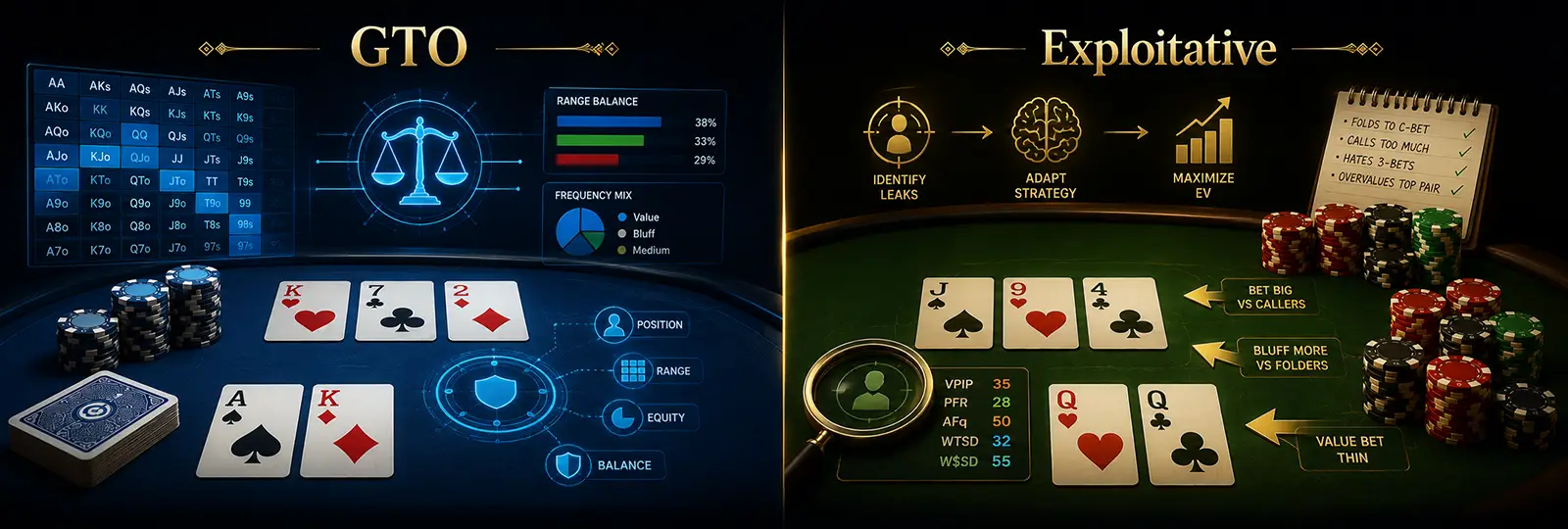
Once you understand ranges, position and basic maths, you can move towards structured models for tough spots. Advanced poker strategies blend balanced play with targeted adjustments that punish clear leaks. These advanced poker strategies balance theory and adjustment, and this balance protects you from strong opponents while still extracting value from weaker players.
Game Theory Optimal (GTO)
GTO (Game Theory Optimal) aims to build ranges that cannot be exploited in the long run. In that model, your value hands, bluffs and medium strength holdings appear in fixed ratios, which prevent opponents from gaining automatic profit by calling too much or folding too much. Solvers use computer power to approximate these balanced strategies and show how ranges should react to different bet sizes and board textures.
You do not need full solver outputs to benefit from this idea. Simple GTO-based rules include defending the big blind with enough hands to stop automatic profit from small opens, mixing check and bet lines with top pair in some spots and choosing bluff combos that include strong draws. These habits stop strong opponents from running you over in high-traffic games.
Exploitative Play
Exploitative play focuses on what your opponents actually do instead of what they should do. If a player folds too much to continuation bets, you increase your bluff frequency. If another caller refuses to fold top pair, you cut pure bluffs and lean into value. The aim is to adjust faster than your opponents, so that their predictable habits feed your results.
When you find a clear pattern, you can even change preflop ranges, bet sizes and bluff frequencies to push that leak harder. This approach increases variance because big adjustments sometimes collide with the top of the range, but the long-term reward can be significant. Keeping simple notes on tendencies helps you return to the same tables with a ready-made plan.
Player Types (HUD Stats)
Online tracking tools label opponents by tendencies, which helps you decide how to approach each pot. Small samples can mislead, so the goal is to combine observations with HUD stats rather than following one number blindly. A player who voluntarily enters many pots and frequently bets or raises plays a loose-aggressive style. Against this opponent you should tighten your calling range and make more thin value bets, as they tend to pay off too often. A player who rarely enters pots and mostly checks or calls is passive. Against a passive opponent you can increase your bluffing and blind-stealing frequency, because they are less willing to contest pots under pressure.
You can use tags like tight regular, splashy caller or short stack specialist alongside shorthand styles such as TAG and LAG. When a seat never folds to three bets, thin value raises gain appeal, and bluffs lose appeal. When a seat gives up too many blinds, you open wider and use position to isolate. Over time, these adjustments add up even in modest stakes Cash games.
Pre-Flop & Post-Flop Execution
Concepts from earlier sections turn into real pots when you plan lines for each street. Pre-flop / Post-flop planning helps you avoid panic on the turn and river, because you already know which cards are good for your range and which lines suit your hand. Instead of reacting to every bet in isolation, you follow a simple script for common spots.
The 3-Bet and 4-Bet Game
A three bet is a re-raise of an open, and a four bet is a re-raise of that three bet. The 3-bet / 4-bet game works best when you split your range into strong value hands, suitable bluff candidates and folds. Value hands include strong pairs and premium broadways that perform well even when stacks go in before the flop. Bluff candidates include suited aces and suited connectors that block strong calling hands.
Position shapes these ranges. Late position attacks blinds with wider three-bet ranges, while early position respects re-raises more and continues mainly with premium holdings. When stacks are shallow compared to the pot, aggressive three-betting can create profitable spots where a single continuation bet on the flop picks up dead money.
C-Betting (Continuation Bet)
A continuation bet is a bet on the flop after raising pre-flop. C-bet (Continuation bet) decisions follow the story told by your opening range and the board texture. On dry boards where your range holds stronger top pairs and overpairs than your opponent, small continuation bets pressure weaker holdings and protect your checking range. On wet boards that hit the caller’s range hard, checking more hands and betting bigger with strong value keeps your line coherent.
Balanced continuation betting also opens room for creative lines. When opponents start to float too many flops, you can plan delayed continuation bets on the turn or mix in check-raising lines with strong hands and well-chosen bluffs. This keeps them from auto-calling flop bets and folding every turn.
Double Barreling (Turn & River)
Double barreling means betting again on the turn and sometimes again on the river after betting the flop. Successful double barrels lean on cards that improve your range and hurt your opponent’s range. High overcards, scare cards that complete obvious draws and bricks that keep your perceived range ahead all act as strong candidates.
Check-raise lines become powerful weapons when opponents stab with weak hands after you miss your first continuation bet. For example, you can check a strong top pair on the flop, call a small turn bet, then check-raise river cards that strongly favour your range. Planning which hands will double barrel and which hands will slow down prevents random aggression and protects your stack when the runout shifts.
Online Poker Strategies: Digital Nuances

Online environments introduce features that live tables do not, including tracking tools, lobby filters and instant seating. Strategies for poker are shaped by these conditions and focus on how players adapt their decision-making to a faster pace and higher hand volume. The emphasis remains on solid fundamentals, but they are applied with greater discipline and structure. The overall aim is to combine technically sound play with informed game selection in a setting where efficiency and consistency directly affect long-term results.
Using HUDs (Heads-Up Displays)
Heads up displays overlay statistics on your opponents that show how many hands they play, how much they raise and how much they fold to aggression. These tools help you see whether a regular player folds too many big blinds or defends correctly against steals. When used correctly, they support your reads instead of replacing them.
You can mark hands where stats surprise you and review them later, refining your lines against each profile. In a busy online poker room, this feedback loop keeps you improving even across short sessions. You still rely on basic observation at new tables, but stats handle the record-keeping.
Multi-Tabling Strategy
Multi-tabling lets you play several tables at once and increase your hourly volume. The key is to cut fancy lines and focus on strong fundamentals, because decisions come quickly across windows. Tighten your opening ranges slightly, avoid marginal spots under pressure and mark tricky hands for review instead of trying to solve them mid-session.
As volume increases, automated routines such as preselected bet sizes, standard continuation lines and simplified bluff trees protect your focus. When you feel decision quality dropping, closing a table is better than forcing action under stress. Long-term progress comes from consistent application, not from a single extended grind.
Table Selection
Part of learning the best poker strategies is selecting tables where those methods can be executed against weaker players. Instead of jumping into the first open seat, you can scan for tables with short stacks, passive players and visible mistakes. Lobby stats such as average pot size and players per flop give clues about how loose or tight a game plays. Choosing tables where several players call too many raises, chase weak draws and pay off river bets gives your edges more room.
Tournament (MTT) vs. Cash Game Strategy
Different formats reward different risk levels. A Poker tournament (MTT) pays only players who reach the prize pool, while cash tables let you buy in and cash out at any time. Stack sizes, blind levels and payout structures all change how you should approach marginal spots.
Cash Games
In cash formats, stacks are measured in fixed big blinds, and you can reload when you lose a pot. Deep stacks reward patient value hunting, careful bluff selection and precise bet sizing. Because each chip has a constant value, folding a marginal spot now preserves money for a clear edge later.
You can sit in lineups that you beat and leave when regulars take over. These games work well for players who enjoy steady session planning and precise post-flop play. Most serious long-term players start by refining their skills in ring games before moving into formats with heavier ICM pressure.
Tournaments
In tournaments, blinds rise over time, and stacks move from deep to shallow. Early levels reward tight play that avoids marginal confrontations, while later levels demand skilful use of fold pressure and aggression near the bubble. Short-stack push-fold charts help you decide when to re-raise over opens or open-shove profitable holdings.
ICM effects grow as you near pay jumps, making it correct to pass on thin spots that risk your stack against covered opponents. Satellite events and bounty formats add extra layers to these decisions. Studying hand histories from deep runs builds intuition for which spots require chips and which spots can wait for a better seat draw.
Bankroll Management as a Strategy

Good bankroll planning protects you from downswings so that rough patches do not wipe you out. A simple rule for most formats is to keep at least thirty to fifty buy-in units for the stakes you play and to move down when your bankroll drops below that range. This cushion absorbs inevitable swings and keeps you playing your A game.
Tracking results in a spreadsheet or tracker shows how swings relate to your style and format. High-variance formats, such as hyper-turbo sit-and-go events or large-field tournaments, require more buy-ins than slow cash tables. Planning your average table count, volume, and risk per session lets you align goals with real numbers.
Linking deposits to a separate payment method and setting clear deposit limits prevents emotional top-ups after heavy sessions. Planning each deposit as part of a monthly entertainment budget keeps gaming under control and turns money spent to gamble into a conscious choice instead of an impulse. Combining bankroll management with responsible gambling tools such as time reminders and cooling-off periods keeps the game within healthy boundaries.
Conclusion
There is no single system that covers every possible spot, but structured thinking turns complex trees into simple branches. Solid fundamentals in position, hand selection, and bet sizing connect with clear maths to create repeatable decisions. Over time, the habits in this guide link together into a personal roadmap that fits your format, volume and goals.
Blending theory with review sessions, note-taking and honest tracking of your results steadily improves your edge. You can explore higher stakes or new formats once your bankroll, skills and mindset support that move. With patience and discipline, a focused approach to gaming turns raw interest into more reliable long-term winning.
FAQs
What Is The Best Poker Strategy For Beginners?
The best way to start is to play fewer hands from early positions, use a tight aggressive style in late positions and fold weak pairs and dominated hands before the flop.
Does This Strategy Apply To Video Poker?
No. Video poker is a standalone casino game played against a machine with fixed pay tables, where optimal decisions are based on predefined hold/discard charts rather than opponent behaviour, betting patterns or table dynamics used in poker.
How Do I Improve My Betting Strategy?
Review hand histories where you faced big bets or made large bets yourself, and check whether the maths and ranges supported your decision. Focus on pot odds, value bet sizing and bluff frequency so that each street fits a clear plan inside structured betting strategies in poker.
Is Online Poker Strategy Different From Live Poker?
Digital play adds tools like tracking software, multiple tables and quick seating, while live play gives you physical tells and a slower pace.