








Poker is one of the most popular casino games in the world, and Texas Hold’em is the version you’ll most often encounter when playing online poker. Easy to learn yet challenging to master, Hold’em combines simple online poker rules with deep strategy, making it ideal for both beginners and experienced players.
In this guide, you’ll learn how to play online poker in just a few minutes, understanding the basic poker rules of Texas Hold’em and getting familiar with betting rounds, hand rankings, and gameplay. Whether you’re joining your first online table or refreshing your knowledge before playing real money, this beginner’s guide will give you confidence in your game, help you avoid common mistakes, and enjoy the game from the very first hand.
The Goal: Making the Best 5-Card Hand
In Texas Hold’em poker, the main goal is simple: to make the best five-card hand or convince your opponents to fold before the showdown by using the correct poker actions. Each player combines their cards with the community cards on the table to form the final hand, following standard poker game rules used in both live and online play. At the end of the round, the player with the highest five-card hand wins the pot. If all other players fold, the remaining player wins automatically, and no cards need to be shown under common poker casino rules.
Poker hand rankings are universal, ranging from high card to royal flush, and understanding them is essential for making the right decisions at the table. What makes Texas Hold’em unique is that you are not limited to using all your hole cards. You can use any five-card hand from the seven available to you. This flexibility creates countless possibilities and strategic depth, rewarding players who can read the board, calculate odds, and adapt to different poker situations.
Hole Cards vs. Community Cards
In Texas Hold’em, each player is dealt two hole cards, known as pocket cards, visible only to them. These cards form the basis of your hand and greatly influence your decisions before and after the flop. Strong starting pocket cards can give you an early advantage, but they don’t guarantee a win.
In addition to pocket cards, the game uses five community cards, dealt face-up in the center of the table. These cards are shared by all players and are revealed in stages: the flop (three cards), the turn (one card), and the river (one card). To make your final hand, you combine your two hole cards with the community cards, or even use only the community cards if they create a stronger hand. Knowing how your hole cards interact with the community cards is key to assessing hand strength and betting wisely.
Poker Hand Rankings (Cheat Sheet)
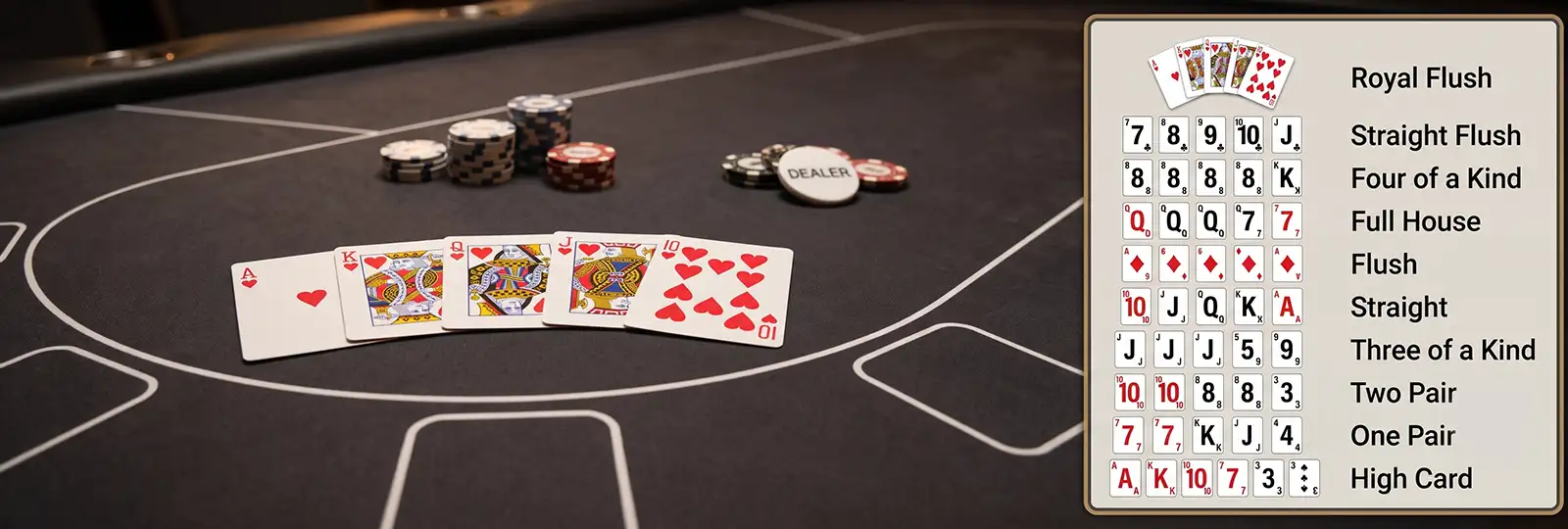
Understanding poker hand rankings is essential if you want to play Texas Hold’em confidently, especially online where decisions move fast. Every poker hand is ranked by how rare it is, and the stronger the hand, the less often it appears. When two or more players reach a showdown, the player with the highest-ranking five-card hand wins the pot. If players hold equal hands, the pot is split between them.
This cheat sheet lists poker hands from strongest to weakest so you can quickly learn and remember them. Whether you are a beginner or just need a refresher, knowing these rankings will help you read the board correctly, avoid costly mistakes, and make smarter betting decisions.
- Royal Flush: Ace, King, Queen, Jack, and Ten of the same suit. This is the strongest possible hand in poker.
- Straight Flush: Five consecutive cards of the same suit (e.g., 9–8–7–6–5).
- Four of a Kind (Quads): Four cards of the same rank plus one side card (kicker).
- Full House: Three cards of one rank and two cards of another rank.
- Flush: Five cards of the same suit, not in numerical order.
- Straight: Five consecutive cards of mixed suits. Aces can be high or low.
- Three of a Kind (Trips or Set): Three cards of the same rank with two unrelated cards.
- Two Pair: Two different pairs plus one kicker card.
- One Pair: Two cards of the same rank with three kickers.
- High Card: No matching cards. The highest card determines the winner.




The Game Interface
When you play poker online, the game interface is designed to make gameplay fast, clear, and beginner-friendly. You will see the poker table, player seats, chip stacks, community cards, and action buttons displayed on your screen. Betting options appear when it is your turn, allowing you to choose how to act within a set time limit. Learning what each button means helps you avoid mistakes and play with confidence, especially during fast-paced online games.
Check
Checking means you choose not to bet when no wager has been made before you in the current betting round. By checking, you stay in the hand without adding chips to the pot. This option is only available if no other player has bet. Players often check to see the next community card for free or to keep the pot small with a weaker hand.
Bet
Betting means you place the first wager in a betting round. When you bet, you add chips to the pot and force other players to respond by calling, raising, or folding. Bets are used to build the pot with strong hands or to apply pressure on opponents. Online tables usually show minimum and maximum bet sizes to guide your decision.
Call
Calling means you match the current bet made by another player. By calling, you stay in the hand without increasing the wager. This action is commonly used when you believe your hand has potential but you are not confident enough to raise. Calling allows you to see the next card while keeping your investment controlled.
Raise
Raising means you increase the current bet after another player has wagered. This action shows strength and puts extra pressure on your opponents. A raise forces other players to either call the higher amount, re-raise, or fold. Raises are often used with strong hands or as a strategic bluff to gain control of the pot.
Fold
Folding means you give up your hand and forfeit any chips you have already placed in the pot. This action ends your involvement in the current hand. Players fold when their cards are weak or when the cost to continue is too high. Folding is an important skill that helps protect your bankroll over time.
Betting rounds
Texas Hold’em is played over a series of structured betting rounds. Each round gives players a chance to check, bet, call, raise, or fold based on the strength of their hand and the community cards on the table. Understanding the order of these stages helps you follow the flow of the game and make better decisions at every point.
The Blinds
Before any cards are dealt, two players post forced bets called the small blind and big blind. These blinds create action and ensure there is always something to win in each hand. The small blind sits to the left of the dealer button, and the big blind sits to the left of the small blind. Blind amounts are fixed based on the table limits.
The Deal (Pre-Flop)
Each player is dealt two face-down cards called hole cards. After the deal, the first betting round begins, starting with the player to the left of the big blind. Players decide whether to call the blind, raise, or fold based on their starting hand strength.
The Flop
The dealer places three community cards face up in the center of the table. These cards are shared by all players. A new betting round begins, starting with the first active player to the left of the dealer button. The flop often has the biggest impact on hand strength.
The Turn
A fourth community card, called the turn, is dealt face up. Another betting round follows. With four community cards visible, players can better evaluate their hand and potential draws, making betting decisions more precise.
The River
The fifth and final community card is dealt face up. This is the last chance to improve your hand. A final betting round takes place, often involving the strongest bets as players commit based on completed hands.
The Showdown
If two or more players remain after the final betting round, the showdown occurs. Players reveal their cards, and the best five-card poker hand wins the pot. If hands are equal, the pot is split between the winners.
Betting Structures
Poker games use different betting structures that control how much players can wager during each betting round. Understanding these formats is important because they affect strategy, risk, and overall gameplay. The three most common betting structures are No-Limit, Pot-Limit, and Fixed Limit.
No-Limit (All-In)
In No-Limit poker, players can bet any amount of their chips at any time, up to their entire stack. This includes the option to go all-in on a single hand. No-Limit games create high pressure situations and allow for aggressive strategies, big bluffs, and dramatic swings. Texas Hold’em is most commonly played in the No-Limit format, especially in online and tournament games.
Pot-Limit
Pot-Limit poker restricts the maximum bet to the current size of the pot. Players may bet or raise any amount up to that limit, but not more. This structure offers more flexibility than Fixed Limit while preventing extremely large bets early in a hand. Pot-Limit games reward careful pot management and are popular in formats like Omaha poker.
Fixed Limit
In Fixed Limit poker, bet and raise sizes are predetermined and cannot be changed. Each betting round has a set amount, with limits often increasing in later rounds. This structure reduces risk, slows down the game, and makes bankroll management easier. Fixed Limit is well suited for beginners who want a more controlled poker experience.
How to Play Online: Technical Basics

Playing poker online involves more than just knowing the poker betting rules. Online platforms include built-in tools and settings that help the game run smoothly and keep play fair for everyone at the table. Understanding these technical basics will help you avoid common errors, act on time, and focus fully on making good poker decisions.
The Time Bank
The time bank is a feature used in online poker to give players extra thinking time when facing a decision. Each player is given a set amount of time to act on every turn. If that regular time runs out, the time bank automatically activates and provides additional seconds to make your choice. Once your time bank is used up, future decisions must be made within the standard time limit.
The time bank is especially useful during complex situations, such as deciding whether to call a large bet or make a big raise. Managing it wisely is important, as wasting time can slow the game and lead to rushed decisions later. Many players save their time bank for difficult hands and act quickly during routine situations.
Auto-Post Blinds
Auto-post blinds is a convenience setting that automatically places the small blind and big blind for you when it is your turn. When enabled, the software posts these forced bets without requiring manual confirmation, allowing the game to move faster and more smoothly. This feature is particularly helpful when playing multiple tables at once.
If auto-post blinds is turned off, you will be prompted each time to post or sit out. Failing to post blinds can cause you to miss hands or be temporarily removed from the table. Most players keep this option enabled to avoid interruptions and ensure consistent participation in every hand.
Mechanical Mistakes
Mechanical mistakes are errors caused by inexperience, inattention, or misunderstanding the game mechanics rather than poor strategy. These mistakes are common for beginners playing poker online, where fast action and automated buttons can lead to costly slips. Learning to recognize and avoid mechanical mistakes will help protect your chips and improve consistency at the table.
Bet Sizing Errors
Bet sizing errors happen when players choose bet amounts that do not match their goal in the hand. Betting too small can give opponents good odds to call, allowing them to chase draws cheaply. Betting too large can scare away worse hands or risk too many chips with marginal holdings. Online poker makes these mistakes easy by offering preset bet buttons that may not suit every situation.
Good bet sizing considers the size of the pot, the strength of your hand, the stage of the game, and your opponent’s tendencies. By thinking through why you are betting and what you want opponents to do, you can avoid leaking chips through poorly chosen bet sizes.
Misreading the Board
Misreading the board occurs when players fail to correctly interpret the community cards on the table. This can include overlooking possible straights, flushes, or full houses, or misjudging how the board connects with an opponent’s likely hand. In online poker, fast-paced play and multitabling increase the risk of this mistake.
To avoid misreading the board, slow down during each betting round and recheck the community cards before acting. Pay attention to suits, sequences, and paired cards. Developing the habit of scanning the board carefully will help you make more accurate decisions and avoid costly errors at showdown.
Conclusion
Texas Hold’em remains one of the most rewarding and accessible casino card games, especially in the online format. By learning the rules of poker, understanding betting structures, mastering hand rankings, and avoiding common mechanical mistakes, you give yourself a solid platform to grow as a player. Poker is not about winning every hand, but about making smart decisions over time. Start slowly, practice often, and focus on consistency rather than quick results. With patience and experience, the skills outlined in this poker guide will help you enjoy the game more and play with greater confidence at any online poker table.
FAQs
What Happens If Two Players Have The Same Hand?
If two players have the same five-card poker hand at showdown, the pot is split evenly between them. This is called a tie or chopped pot. If players share the same hand using only community cards, all remaining players divide the pot equally.
Does The Suit Of The Cards Matter?
Card suits do not have a ranking in poker. A flush in hearts is equal in value to a flush in spades or any other suit. Suits only matter for determining whether a flush is made, not for breaking ties between hands.
What Is The “Dealer Button”?
The dealer button is a marker that shows which player is acting as the dealer for the current hand. It moves one seat clockwise after each hand. The button determines the order of betting and who posts the blinds.
Can I Play Poker For Free?
Yes, most online poker sites offer free play or practice tables. These games use virtual chips and allow you to learn the Texas Hold’em rules, test strategies, and become comfortable with the software without risking real money.