
Legal States for Sweepstakes Casinos: State Legality Map
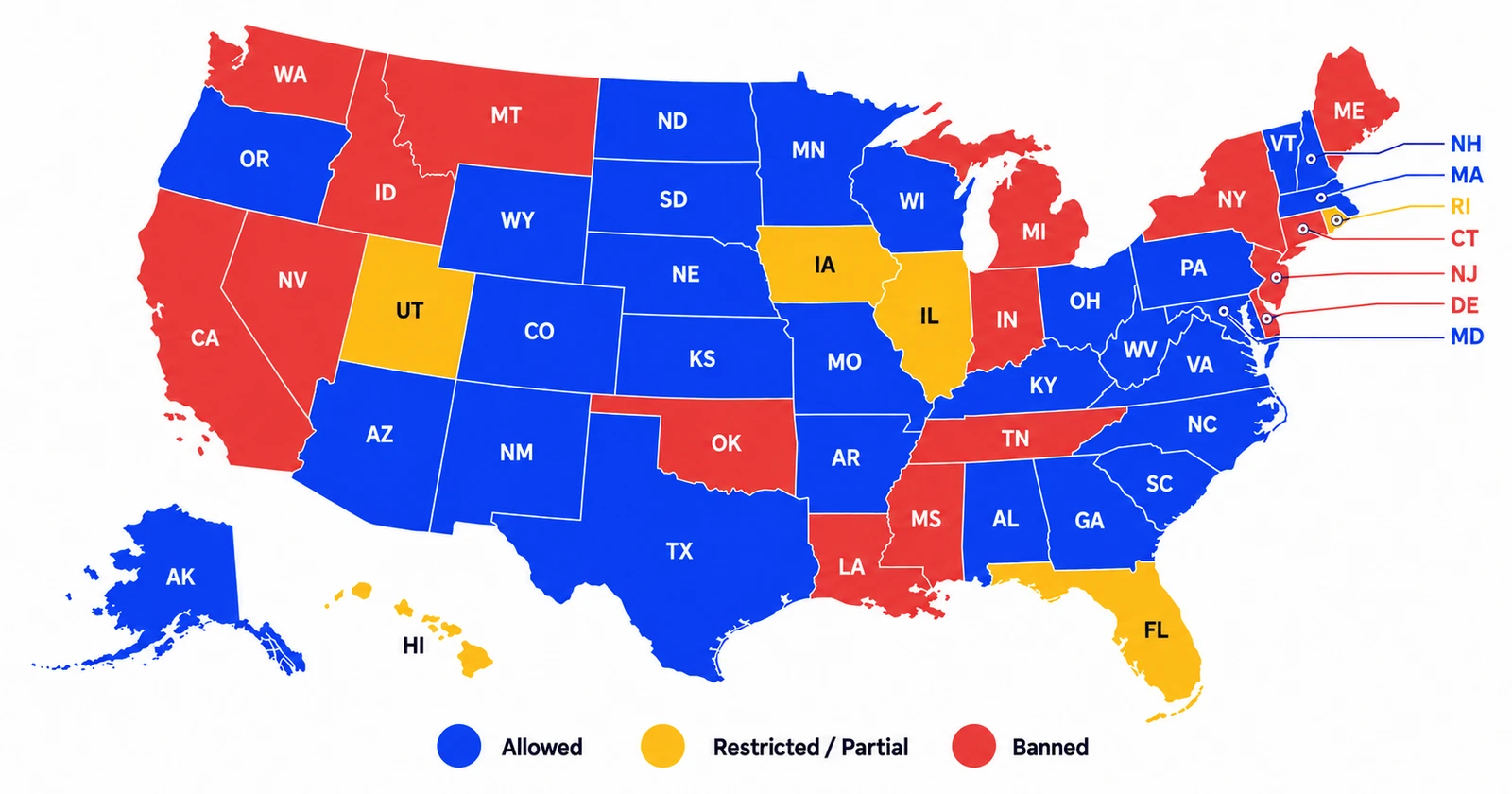
This map reflects the supplied state-by-state information for 2026. Laws and restrictions may change.
The promotional gaming environment across the United States is experiencing an unprecedented regulatory restructuring. Historically governed by uniform federal promotional policies, the domestic market for online social and sweepstakes-themed casino platforms has splintered into an intricate, localized patchwork of compliance rules.
While federal statutes protect genuine sweepstakes platforms that do not require money to play, individual state governments retain the absolute authority to redefine what constitutes value and illegal gambling within their specific borders. As a result, the question are sweepstakes legal depends on state-specific laws and regulatory interpretations.
Top Legal Sweepstakes Casinos in the US (2026)
Available to players aged 18+ in compliant states. Excludes WA, ID, NV, MI, CA, NY, and other restricted jurisdictions.








Current Legal Status of US Sweepstakes Casinos in 2026
The structural architecture of the domestic sweepstakes ecosystem faces severe operational threats. Historically, digital gaming brands leveraged a unique, dual-currency billing model to safely deploy simulated casino games into states lacking formalized iGaming laws, maintaining compliance under the Federal Trade Commission policies and traditional consumer sweepstakes guidelines by completely removing mandatory purchases from the participation loop.
However, recent aggressive enforcement initiatives and legislative bills have systematically reduced the total landmass accessible to these platforms. Jurisdictions like California, New York, New Jersey, and Oklahoma have shifted their laws to outright eliminate promotional casino exemptions, forcing premium multi-state entities to rapidly pull their services out of highly populated states to avoid civil penalties. Consequently, only about 30 states continue to provide an open, unrestricted regulatory environment for dual-currency sweepstakes platforms.
Interactive US Map & Quick State Availability Matrix
Navigating the complex landscape of promotional gaming requires a clear understanding of how each jurisdiction categorizes virtual currencies and prize redemptions. The matrix below provides a streamlined breakdown of state classifications, highlighting where you can play freely, where caps apply, and which regions enforce total operational bans in 2026.
| State Type | Legal Status Description | Key Excluded or Restricted States |
|---|---|---|
| Fully Compliant | Unrestricted access to both Gold Coins and Sweeps Coins ecosystems. Cash and gift card redemptions are fully permitted. | None (Examples include Texas, Arizona, Colorado, and Ohio) |
| Operational Caps | Platforms are permitted to operate legally, but state statutes mandate restrictive daily limits on cash-out prize values. | New York ($500 max per single win historically), Florida ($5,000 max single-session cap) |
| Recently Banned | Sweeping statutory updates or new legislative bills explicitly outlawing dual-currency simulation models between 2024 and 2026. | California, New York, New Jersey, Indiana, Maine, Louisiana, Oklahoma |
| Legacy Prohibited | Long-standing state gambling laws that explicitly prohibit promotional or social models that offer real-world prize conversions. | Washington, Idaho, Michigan, Nevada, Montana |
States Breakdown: Allowed, Restricted, and Fully Banned Jurisdictions
State-level regulatory bodies, municipal law enforcement offices, sovereign tribal gaming coalitions, and state Attorneys General are no longer treating promotional social gaming as an un-regulated gray area. Local administrative bodies are actively establishing clear boundaries for digital platforms.
Fully Banned States (Strictly Prohibited)
- Washington: The most restrictive gaming jurisdiction in the nation. State gambling statutes explicitly categorize any form of digital sweepstakes simulation featuring redeemable value as an illegal game of chance.
- Idaho: Employs explicit statutory code that completely bars commercial entities from utilizing promotional dual-currency loops to issue real cash or physical merchandise redemptions to local players.
- Michigan: Following intense regulatory pressure launched by the Michigan Gaming Control Board, the state successfully closed all legal paths for sweepstakes operators, leading to a complete market exit by national brands.
- Nevada: Maintains an absolute monopoly over casino gaming through the Nevada Gaming Control Board. State laws decree that any interactive mechanism mirroring a slot machine or table game must be fully licensed by the state.
- Montana: Solidified its hardline opposition to the digital gray market by enacting strict statutory revisions that directly targeted and outlawed social sweepstakes systems.
States with Recent Legislative Bans or Cease-and-Desist Actions
- California: Enacted Assembly Bill 831, which effectively dismantled the promotional social gaming framework. The bill criminalizes the deployment of online dual-currency software and holds third-party support partners civilly and criminally liable.
- New York: Enacted sweeping legislative prohibitions that systematically outlawed virtual-currency promotional setups, prompting all major national sweepstakes operators to execute full operational phase-outs.
- New Jersey: Codified explicit statutory updates that treat simulated casino apps utilizing promotional cash prize redemptions as un-licensed gambling enterprises, making operations entirely illegal.
- Indiana & Maine: Both jurisdictions finalized direct legislative bans (including Indiana HB 1052 and Maine LD 2007) that criminalized interactive dual-currency apps and forced immediate brand pullouts.
- Louisiana: Enacted House Bill 883 alongside House Bill 53, expanding computer-based gambling prohibitions to cover promotional sweeps models, coupled with strict state anti-racketeering laws.
- Oklahoma: Following a decisive legislative override of the governor’s executive veto, the state codified Senate Bill 1589. The law classifies dual-currency promotional frameworks as criminal gambling offenses to insulate its extensive tribal gaming industry.
- Illinois & Mississippi: State casino boards and regulatory commissions issued massive waves of administrative cease-and-desist mandates, forcing operators out of these jurisdictions.
States with Prize Redemption Caps or Operational Restrictions
- Florida: While the state permits the overall use of social casino platforms, strict consumer protection laws enforce a mandatory $5,000 single-round or single-session prize redemption maximum.
- New York (Legacy Rules): Before passing its absolute legislative ban, the state implemented a restrictive $500 ceiling on any individual promotional contest redemption payout.
- Rhode Island: Enforces rigorous corporate promotional registration, financial bonding, and administrative filing requirements that make it economically unviable for smaller sweepstakes operators.
Fully Legal States with Unrestricted Play
- Texas: Represents the largest remaining open market for promotional gaming software in the country, heavily relying on traditional constitutional sweepstakes exemptions.
- Arizona & Colorado: Both states officially recognize standard commercial promotional frameworks, ensuring that as long as the underlying games maintain a verified free entry mechanism, the platform is fully legal.
- Pennsylvania: Continues to permit the operation of national sweepstakes casino models, serving as a highly lucrative hub, though state assembly members continue to evaluate potential taxation and regulatory frameworks.
- Other compliant states: Jurisdictions such as Alabama, Alaska, Massachusetts, New Hampshire, North Carolina, Wisconsin, and Virginia remain highly accessible and compliant environments.



Comprehensive 50-State Legal Guide for Sweepstakes Gaming
Because sweepstakes laws are governed at the state level rather than federally, players face entirely different rules depending on their physical location. This comprehensive 50-state guide breaks down the legal landscape into core regional groups, outlining exactly where operators are permitted to distribute promotional prizes.
| Jurisdiction | Legal Status (2026) | Notes / Restrictions |
|---|---|---|
| Alabama – Connecticut | Split Environment | Alabama remains fully open; Connecticut enforces a strict, explicit statutory ban. |
| Delaware – Iowa | Deeply Restrictive | Delaware protects its state-regulated lottery iGaming monopoly; Iowa maintains aggressive oversight. |
| Kansas – Missouri | Universally Open | Unrestricted consumer promotional laws apply across standard platforms in these regions. |
| Montana – Pennsylvania | Fractured Framework | Montana maintains an absolute ban; Pennsylvania remains an open, high-volume market. |
| Rhode Island – Wyoming | Restricted to Open | Rhode Island features heavy promotional bonding rules; Wyoming offers unrestricted access. |
Alabama to Connecticut
- Alabama: Fully Legal. Local players can freely access national platforms and complete Sweeps Coins prize cash-outs without regulatory issues under established common law definitions.
- Alaska: Fully Legal. Standard state promotional guidelines apply, and no anti-sweepstakes bills have advanced through the remote state’s legislature.
- Arizona: Fully Legal. Operates under clear, compliant state consumer rules provided the free-play option is prominently accessible.
- Arkansas: Fully Legal. Local statutes contain no restrictive or limiting clauses directly targeting dual-currency entertainment apps.
- California: Fully Banned. Outlawed entirely by Assembly Bill 831, which turned all related operations and vendor support into a misdemeanor offense.
- Colorado: Fully Legal. A robust and open market for premier promotional platforms, operating in full alignment with local business standards.
- Connecticut: Fully Banned. State statutes offer zero room for un-licensed online casino simulations, rendering the promotional model illegal.
Delaware to Iowa
- Delaware: Fully Banned. The state-run lottery exercises an absolute, legally protected monopoly over all digital slot and table games.
- Florida: Restricted. Fully legal to access, but state prize limits strictly cap single-win promotional distributions at a maximum of $5,000.
- Georgia: Fully Legal. Employs a highly stable promotional law framework that safely accommodates dual-currency gaming mechanics.
- Hawaii: Restrictive. General anti-gambling statutes make national operators hesitant to offer cash prize redemptions, though no direct sweeps ban is codified.
- Idaho: Fully Banned. Long-standing statutory provisions completely exclude promotional casino apps from executing prize cash-outs.
- Illinois: Restricted. The Illinois Gaming Board has escalated its scrutiny, issuing numerous cease-and-desist warnings to several digital platforms.
- Indiana: Fully Banned. House Bill 1052 successfully instituted civil penalties for conducting online sweeps, causing an industry-wide pullout.
- Iowa: Restrictive. Senate File 2289 explicitly expanded the state’s gaming enforcement authority to target un-licensed interactive sweeps models.
Kansas to Missouri
- Kansas: Fully Legal. Traditional sweepstakes protections remain firmly intact, allowing unrestricted access to social gaming options.
- Kentucky: Fully Legal. Platforms are widely available across the state, despite historical civil litigation involving real-money digital operators.
- Louisiana: Fully Banned. House Bill 883 and House Bill 53 officially categorized dual-currency software as illegal gambling by computer.
- Maine: Fully Banned. Legislative bill LD 2007 effectively outlawed casino-style simulations using virtual dual-currency structures.
- Maryland: Fully Legal. The state permits compliant promotional sweeps setups, though lawmakers frequently review out-of-state operators.
- Massachusetts: Fully Legal. Continues to serve as a highly stable, open market under traditional commercial promotional regulations.
- Michigan: Fully Banned. The Michigan Gaming Control Board systematically pushed out top operators via aggressive gray-market crackdowns.
- Minnesota: Fully Legal. Fully operational under standard state sweepstakes rules, despite occasional legislative debates.
- Mississippi: Fully Banned. The State Gaming Commission enacted an aggressive strategy, sending regulatory cease-and-desist orders to all known apps.
- Missouri: Fully Legal. Offers an entirely open and uninhibited legal landscape for compliant, multi-state social casino platforms.
Montana to Pennsylvania
- Montana: Fully Banned. State lawmakers explicitly amended local penal codes to outlaw social and promotional dual-currency setups.
- Nebraska: Fully Legal. Completely open for standard dual-currency platforms, though the minimum legal entry age is elevated to 19.
- Nevada: Fully Banned. Requires all casino-themed mechanics to be fully vetted and licensed under traditional brick-and-mortar casino laws.
- New Hampshire: Fully Legal. Maintains standard, open-market compliance for all major national sweepstakes entities.
- New Jersey: Fully Banned. State legislators codified strict statutory updates that completely criminalized promotional social casino models.
- New Mexico: Fully Legal. Standard state and federal consumer promotional exemptions remain fully active and recognized.
- New York: Fully Banned. Completely phased out following targeted legislative updates that classified these platforms as un-licensed gambling.
- North Carolina: Fully Legal. Remains an exceptionally active, high-volume state for compliant dual-currency social casino platforms.
- North Dakota: Fully Legal. Traditional sweepstakes protections ensure local players face no restrictions when accessing compliant apps.
- Ohio: Fully Legal. Fully accessible, though the Ohio Casino Control Commission closely monitors the evolution of promotional definitions.
- Oklahoma: Fully Banned. Senate Bill 1589 classified dual-currency sweepstakes platforms as criminal gambling enterprises to protect tribal casinos.
- Oregon: Fully Legal. Standard social gaming guidelines apply, creating a safe operational space for top-rated platforms.
- Pennsylvania: Fully Legal. Fully compliant and accessible, though the state’s robust real-money iGaming market drives ongoing legislative review.
Rhode Island to Wyoming
- Rhode Island: Restrictive. Meticulous promotional filing and bonding mandates exist to protect the state’s official licensed iGaming infrastructure.
- South Carolina: Fully Legal. Operates under standard state promotional rules, allowing unrestricted access to virtual social gaming.
- South Dakota: Fully Legal. Fully open and compliant landscape for platforms utilizing standard dual-currency promotional mechanics.
- Tennessee: Fully Banned. Anti-sweepstakes bills successfully advanced through the state legislature, enacting strict statutory prohibitions.
- Texas: Fully Legal. Serves as the most stable and financially lucrative legal market for promotional social gaming in the United States.
- Utah: Restrictive. Strict constitutional bans on all forms of gambling cause operators to employ advanced compliance checks.
- Vermont: Fully Legal. Standard commercial sweepstakes rules protect the ongoing operation of compliant digital platforms.
- Virginia: Fully Legal. Remains completely accessible after multiple attempts to pass restrictive anti-sweepstakes legislation failed.
- West Virginia: Fully Legal. Unrestricted access remains fully available, with platforms operating safely alongside the state’s licensed iGaming sector.
- Wisconsin: Fully Legal. Traditional promotional guidelines are fully preserved, ensuring complete compliance for out-of-state operators.
- Wyoming: Fully Legal. A completely uninhibited market that safely permits access to all primary national sweepstakes casino applications.
Legal Foundation: How the Dual-Currency Sweepstakes Model Works
To operate legally across multiple jurisdictions, these platforms rely on a clever application of commercial advertising laws rather than standard gambling frameworks. By removing the direct financial link between your wallet and the games you play, the entire platform functions as a large-scale consumer marketing promotion instead of a digital wagering house.
Traditional online casinos require you to risk your own capital directly on a game of chance to win money. Sweepstakes casinos break this chain by separating your money from the actual prize-winning mechanic. You are only ever allowed to buy entertainment tokens that have zero value, while the tokens that can win cash prizes are given to you entirely as a free promotional bonus. This specific structural barrier keeps the model compliant under federal laws, effectively classifying the apps as digital sweepstakes contests similar to famous corporate fast-food promotional games.
The “No Purchase Necessary” Rule Explained
To avoid classification as an illegal or un-licensed lottery under both federal and state statutes, a promotional game must completely eliminate the element of consideration. In legal terms, consideration is defined as the payment of money or something of value to participate in a game of chance.
By ensuring that consumers are never required to spend money to play, and by providing accessible paths to win real prizes completely free of charge, the ecosystem legally maintains its status as a promotional sweepstakes. If an operator ever makes a purchase mandatory to unlock prize-winning capabilities, the entire operational structure collapses. Furthermore, this rule requires that the free method of entry stands on equal footing with the paid path; the odds of winning cannot be altered based on whether a participant is playing with free promotional tokens or tokens acquired via purchase bundles.
Gold Coins (GC) vs. Sweeps Coins (SC) Legal Distinction
- Gold Coins (GC): Function as a purely virtual token that users can purchase in bundles. They are designed exclusively for social play, clocking up leaderboard points, and general entertainment. Gold Coins hold absolutely zero real-world value, cannot be converted into cash, cannot be transferred between user accounts, and serve no purpose outside of the app’s casual gameplay modes.
- Sweeps Coins (SC): Function as promotional entries that can never be directly purchased. Instead, they are distributed entirely free of charge as a bonus alongside Gold Coin purchases, through consecutive daily account log-ins, or via direct mail requests. Sweeps Coins are used to enter promotional gameplay modes, and any Sweeps Coins won through these games can eventually be redeemed for real cash distributions or corporate retail gift cards. The legal system views these redemptions as a sweepstakes prize rather than a return on a wager.
Alternative Method of Entry (AMOE) and Mail-In Requests
Extract the Sweepstakes Rules
The user must locate and read the platform’s official sweepstakes terms and conditions page to identify the exact paper size, ink color, and verbiage requirements.
Manually Prepare the Materials
The player must manually write their full legal name, account username, email address, physical residential address, and a uniquely generated digital session code onto a blank, white index card.
Address and Mail the Request
The completed index card must be enclosed within a hand-addressed, stamped envelope and mailed directly to the sweepstakes operator’s designated corporate clearinghouse or processing center.
Manual Account Crediting
Upon receipt and manual verification of the letter, the operator uploads the complimentary Sweeps Coins directly to the user’s digital account, maintaining the legal “No Purchase Necessary” mandate.
Sweepstakes Casinos vs. Traditional Real-Money Online Casinos
Understanding the core differences between promotional platforms and traditional internet betting options comes down to comparing their fundamental regulatory frameworks, financial demands, and geographic availability.
| Operational Factor | Sweepstakes Casinos | Real-Money Online Casinos |
|---|---|---|
| Legal Framework | State & Federal Consumer Promotional Law | State Gaming Boards & Interactive Licensure |
| Primary Currencies | Gold Coins (Play) & Sweeps Coins (Promotional) | Direct USD, Debit Cards, and Cryptocurrency Deposits |
| Purchase Requirement | Strictly Optional (Free entry path must exist) | Mandatory (Users must risk capital to play) |
| U.S. Availability | Legal and accessible in roughly 30 states | Highly restricted (Legal in only 8 states) |
| Tax Classifications | Taxed as Sweepstakes Prizes & Awards (Form 1099-MISC) | Taxed as Standard Gambling Winnings (Form W-2G) |
Age Requirements & Player Identity Verification (KYC)
To maintain consumer safety, prevent fraudulent account creation, and completely eliminate underage play, promotional social platforms utilize strict verification frameworks.
Legal Minimum Age Limits by State (18+ vs. 21+)
While traditional commercial online gambling platforms and land-based brick-and-mortar casino resorts enforce a mandatory minimum age of 21, sweepstakes platforms regularly offer legal access to individuals who are 18 and older. This lower age threshold is permitted because the platforms operate under standard consumer promotional laws rather than gambling codes.
However, individual state exceptions apply. For instance, platforms operating within Nebraska must elevate their minimum entry age to 19 to align with local age-of-majority laws. Furthermore, specific platforms choose to enforce a uniform 21+ cutoff nationwide to simplify compliance and mirror standard casino expectations.
How Social Casinos Verify Your Location and Identity
- Advanced Geolocation Checks: The platform integrates background software to pinpoint the player’s physical coordinates, blocking anyone attempting to log in from a banned or restricted state.
- Know Your Customer (KYC) Submission: Before a user can purchase coin packages or initiate a prize redemption request, they must upload a clear photograph of a government-issued photo identification document, such as a driver’s license or passport.
- Liveness Verification & Address Audit: The software utilizes automated facial scanning technology to match the user’s live face to their identification document, while a recent utility bill or bank statement is cross-referenced to verify their physical residential address.
Top Recommended Legal Sweepstakes Casinos Operating in Compliant States
While the domestic regulatory landscape remains highly volatile, several premium social gaming platforms continue to maintain safe, fully compliant services across major unrestricted jurisdictions in 2026.
| Platform | Best Known For | Accepted Legal States | Excluded Jurisdictions |
|---|---|---|---|
| Chumba Casino | Massive Player Database | Approximately 30 States | CA, NY, NJ, MI, WA, ID, MT, LA, IN, OK |
| Stake.us | Digital Currency Integration | Approximately 30 Compliant States | CA, NY, NV, MI, WA, ID, KY, OK |
| Pulsz Casino | Extensive Slot Portfolio | Open National Markets | CA, NY, NJ, WA, ID, MI, NV, OK |
High-Rated National Platforms
- Chumba Casino: Operated by Virtual Gaming Worlds, this platform stands as the longest-running flagship brand in the social gaming market, widely recognized for its consistent prize redemption processing and customer support infrastructure.
- Stake.us: Serves as a major platform that caters directly to a tech-forward demographic by integrating virtual digital currencies alongside an array of exclusive games and promotional challenges.
- Pulsz: Highly favored by mobile players for its optimized application performance, offering hundreds of classic slot titles, scratchcards, and megaways games sourced from world-class developers.
Regulatory Scrutiny, Active Lawsuits, and the Future of US Sweeps Laws
The rapid commercial expansion of the digital sweepstakes market has attracted intense oversight from federal regulatory bodies, state legislative assemblies, and traditional casino operators.
State Attorney General Inquiries & Legal Challenges
- Mass Class-Action Litigation: Multi-state sweepstakes operators face significant legal pressure from a surge of consumer class-action lawsuits filed across multiple states, including Utah, California, and Ohio. These suits contend that the purchasing mechanics of social casinos violate state consumer protection acts.
- The Tribal Gaming Stance: Sovereign tribal gaming associations view promotional dual-currency platforms as a direct economic threat to their land-based casino monopolies, actively lobbying state legislatures to close promotional loopholes and protect tribal-state gaming compacts.
- The Future Horizon: Legal experts expect the industry to transition away from its historic gray-market model toward a formalized, state-by-state regulatory structure. This shift would mirror the evolution of daily fantasy sports, introducing explicit state licensing fees and consumer protection mandates.

US Tax Obligations for Sweepstakes Casino Cash Prize Winnings
Navigating the financial side of promotional gaming requires a clear understanding of federal guidelines, as the Internal Revenue Service enforces specific reporting mandates on all virtual prize conversions.
FAQs
Are sweepstakes casinos legal in all 50 US states?
No. They are prohibited or restricted in roughly 20 states. Major regions like California, New York, and Michigan have enacted explicit statutory bans or issued regulatory cease-and-desist orders. The legal states for sweepstakes depend on applicable state laws and sweepstakes legal requirements.
Can I get penalized for accessing a sweeps casino using a VPN in a restricted state?
Yes. Masking your location with a VPN directly violates the platform’s binding terms of service. Modern apps use advanced geolocation software to detect VPNs, resulting in immediate account termination and forfeited balances. These restrictions form part of sweepstakes legal compliance.
How do sweepstakes casinos legally pay out real cash prizes?
They operate strictly within the boundaries of established commercial consumer promotional laws. Because Sweeps Coins are distributed solely as free promotional entries, redemptions are legally classified as standard corporate prize payouts. Legal sweepstakes casinos must follow applicable sweepstakes legal rules.
Are cash prize redemptions from sweepstakes casinos taxable by the IRS?
Yes. The IRS treats these payouts as miscellaneous prize income rather than standard gambling winnings. If your total redemptions equal or exceed $600 in a tax year, the operator will issue a Form 1099-MISC.
Why are states like California and New York restricting sweepstakes casinos?
Regulators argue the dual-currency model functions as an unlicensed loophole that avoids state oversight and corporate taxation. These disputes influence sweepstakes casino legal states, including whether sweepstakes casino legal operations are permitted and are sweepstakes casinos legal in california.
Do I need to provide SSN verification before redeeming prizes?
Yes. To comply with federal anti-money laundering regulations, KYC mandates, and IRS reporting standards, operators require your details. These checks may be outlined in a legal disclaimer explaining the legality of sweepstakes casinos in the US and the state-specific laws that apply to their operation.